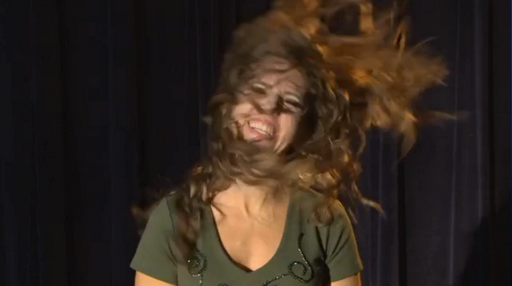
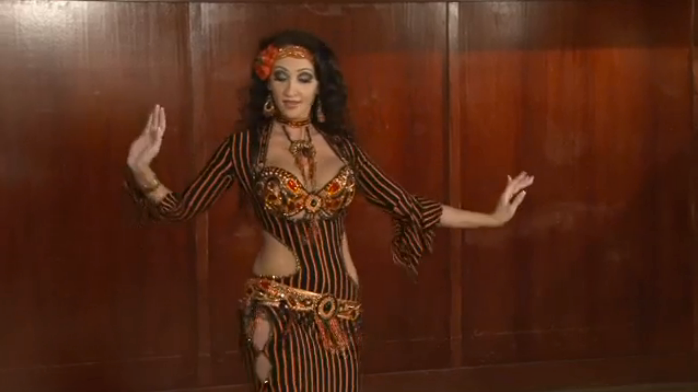
Refining the Dance with Maria Sokolova

This is the one hundredth post on Atisheh Dance! Here’s to a “century” of me futzing around my living room in yoga pants and a hip scarf and then writing about it for the internets!

Yesterday I wrote about putting together my own customized dance practice using Datura Online. However, since I’m not a fan of boundaries, I used Datura for the warmup, drills, and cool down, but got my dance in from RAQStv. And namely, from a video I was reeeeeally excited about, Maria Sokolova’s 15-minute lesson from Project Belly Dance.
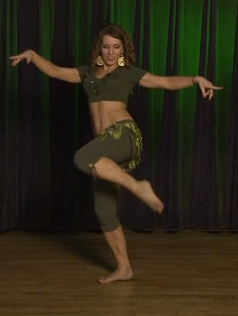
Kick it!

I actually already worked with this video once while I was on holiday, albeit with minimal warmup, so this was my second time doing it. There is quite a bit of material crammed into this little instructional, so it’s the kind of thing that’s worth repeating — and thankfully, RAQStv has it for a month-long rental.

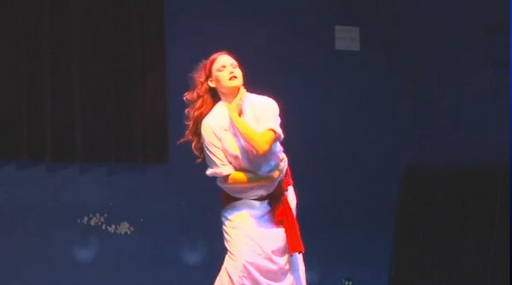
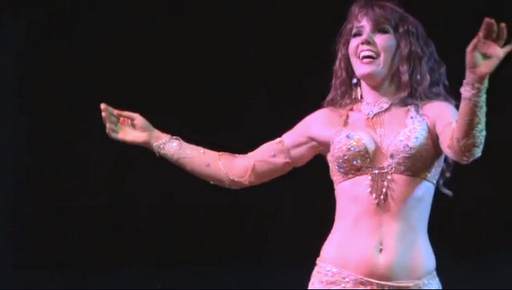
Maria starts by teaching a basic combination facing the camera, then with her back to the viewer. After repeating it for a bit, she starts to go through each section, showing how to add nuance, contrast, and expression to each movement. It might be a particular twist of the torso, a way of moving the arm through space, a lovely variation on a spin, or the quality of expression during a movement.

I adore Maria’s performance style, this is the video I hoped she would make, and I’m so glad she made it. (And I’m just hoping even more that this is exactly what she does for her eventual Cheeky Girls instructional video, but slower, and more.) I think that for anyone who wonders how to get from the basic moves you do in class to a gorgeous performance — sometimes soft and feminine, sometimes assertive and dramatic — this video shows some of the ways to modify movement.
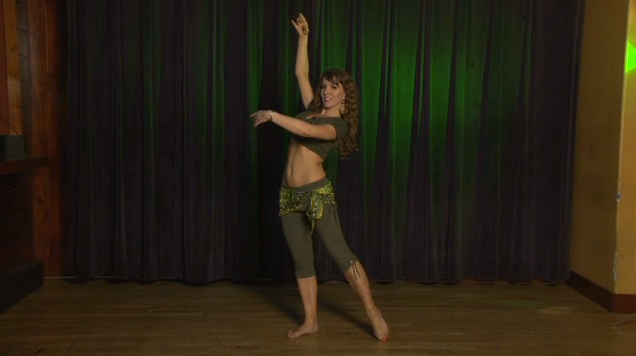
The material is tricky to get on the first time through, which is why it really does bear repeating. The second time I worked with the video, I had already internalized more of the combo, so focusing on the “extras” became easier. And because it is a quick video — it was, after all, the challenge to make a 15-minute instructional — Maria presents some material faster than she probably would in a regular class, especially right at the end. I will definitely do this at least once or twice more so as to learn as much as possible before the rental expires!

My one beef with this video had to do with production: Maria is wearing a green costume, and her background is green curtains! When I projected this, the lack of contrast made it a bit difficult to see her. (It was easier the first time around, when I was working from a large computer screen.) I suspect this is just because Project Belly Dance was being filmed on a time crunch and in the available space, but I still would have preferred a white background.
Stream(lin)ing my practice with Datura Online

Today I hooked up my computer to my projector and tried something new: doing an entire practice using streaming online programs. I’m used to live class, I’m used to just popping a video in and working with it, but I didn’t quite know what to expect. I’m working on a comprehensive review of Datura Online (and have review access for a month for that), but I wanted to work with the offerings out there to customize my very own practice session, just the way I want it. So here’s what I did:

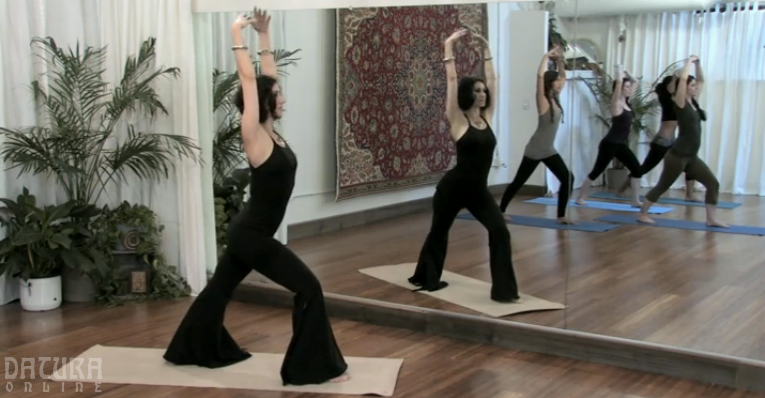
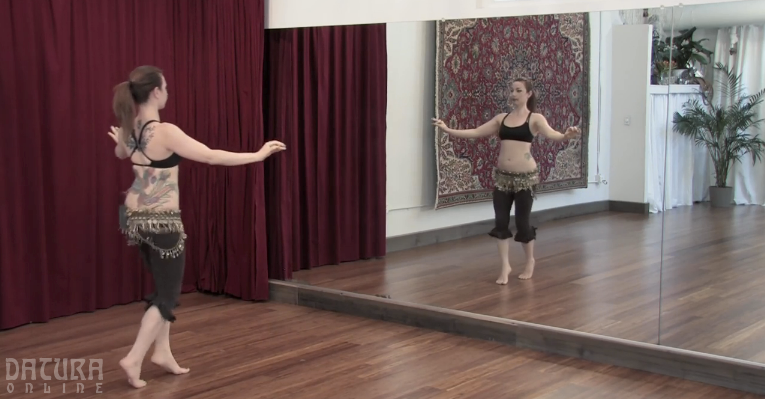
I scrolled to the “topics” section of Datura Online, selected the “Warmup” option and picked a basic little warmup with some ab exercises for toning; in a second tab, went to “Movement” and then “Shimmies” because I’d seen a basic tutorial on layering 3/4 shimmies onto traveling steps; opened up another tab, pulled up RAQStv and loaded Maria Sokolova’s mini-class from Project Belly Dance so I could get a bit of dancing in; and in a final window, got a quick cool-down with yoga focused on the lower back from Datura. I had everything opened in its own tab, and I organized the tabs in order, so that I wouldn’t have to pause too long between segments.

I’m going to talk about Maria’s lesson in a different post, so I can focus on the Datura offerings here.

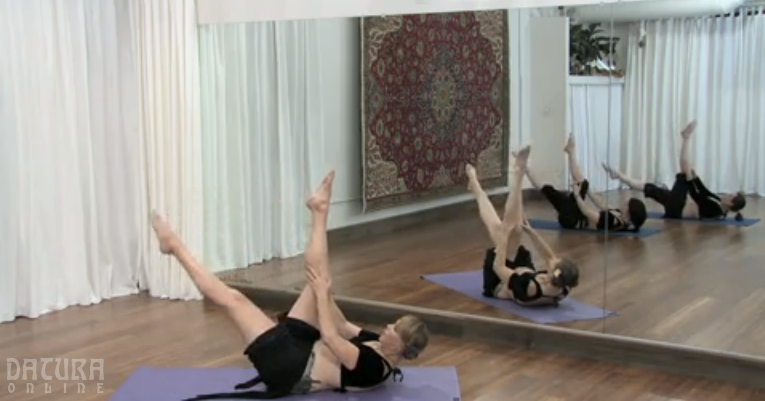
Warmup: Ab Warm Up + Conditioning: #1 with Colette Todorov (12:22 min)

To warm you up, Colette has you do slow, deliberate high steps, adding a few arm moves and twists to add a bit of challenge. It’s the kind of thing that looks very easy, but if you’re holding your stomach in as she instructs, becomes more challenging — especially at the end of a long day.

The real goodness is in the ab exercises. I loooved this bit. It’s short and sweet, but involves doing four different kinds of pilates ab exercises. However, instead of repeating each one for a long time and then switching, Colette has you do combination sets — first four slow, controlled reps of each move, then two. There was burn. It targeted the obliques and the lower abs too. Not the kind of thing that will give you washboard abs, but fun to do, and easy to work into a bellydance practice.

Drills: Basic Traveling with 3/4 Shimmies with Ashley Lopez (20:16 min)

This is a standalone section of a longer workshop on the 3/4 shimmy. I was drawn to it because the preview showed Ashley doing a simple, unaccented 3/4 shimmy. This is what I’m learning in one of my live classes, but is pretty different than what I have on most of my videos, and, indeed, from what I’ve learned in other classes.

Surprisingly, Ashley begins by getting you to do a regular shimmy, then try walking with it, then try smoothing it out. At my level, this is a bit easier said than done, and I had trouble figuring out how I was supposed to do that. Then she goes back to basics — phew! — talks about driving the shimmy from the obliques, and does it very slowly. Once the slow shimmy is going, you start walking forwards and backwards with it. And eventually, Ashley has you walk in a large square doing the shimmy at full speed, then try the shimmy on releve. Finally, she does the 3/4 shimmy on the down, and goes through the drills again.

What I liked: Ashley explains and demonstrates why this shimmy is useful. I find it a less exciting shimmy to watch and do than the “hip up hip out” kind of 3/4 shimmy, but her point is that once you get it down, you can accent whatever you like. She has helpful tricks, like clapping on the “1” before you even start lifting your foot. And, she gives pointers on form, as well as occasional tips on what to focus on if you’re just starting.

What I still wanted: I think it would be helpful to have an exercise to isolate the obliques in the movement, and the rev up to full speed was too fast for me. (Mind you, since I didn’t watch the entire workshop, I don’t know if she does a slower breakdown elsewhere — but I’m reviewing the videos as I find them.) I think this video would be a great drill for someone who already has a 3/4 shimmy going, but wants to polish her form and work on layering it onto traveling moves.

After I was done with the video, I wound up going to a full-length mirror and just working with the shimmy. I found that moving away from the screen was actually useful, maybe even necessary. Once I took Ashley’s tips but just watched myself, trying to get the form right, I started to see and feel improvement. Eventually, I got faster, and I was even able to walk a few steps with it. So I will most likely return to the video, but after I’ve drilled the shimmy for a bit on my own.

Cool Down: Basic Short Yoga Sequence with Rachel Brice (9:07 min)

This is a quick way to stretch out and relax your back after a practice. The exercises Rachel chose here are for both the upper and lower back. They resemble some of the moves in my Viniyoga back videos, but with an extra twist or two. Basically, the cool down is composed of slow motion stretches and movements, timed with inhalation and exhalation, and the result is a delicious feeling of relaxation. Simple, sweet, a winner.

So, it was a good time this evening. It was amazing what could fit into each short segment. The beginning and closing videos were very handy as-is, while the 3/4 shimmy drills needs some, well, preliminary drilling on my part to be do-able. (I will most likely work with the entire workshop for that, so I can get a sense of how Ashley builds up to full speed.)

Taking a breath; getting back to yoga

This morning I decided to do a bit of yoga. Not a big deal, except I haven’t done any in months — and I was enjoying my prenatal yoga so much before I gave birth. I’ve made a lot of time for dance lately, but taking the time to slow down my breath and really focus on the asanas just hasn’t been part of the picture lately. (One exception has been Hala Khouri’s Yoga for Stress Reduction.)

But here’s the thing: there really is nothing like yoga. It got rid of my knee and back pains, and that deep breathing kept me going through a stressful year in my life. So yesterday I bought a copy of Yoga Journal, and today I got my husband to watch the little one while I did a simple, two-page routine for stretching and twisting the back.

I didn’t have the right equipment. I was on a carpet (really not ideal for downward dog), wearing bellydance pants. But that barely mattered. It was so, so difficult to slow and deepen my breath at first. I think this is partly due to the fact that my dance courses have encouraged keeping tight abdominals and breathing into the rib cage, so I had to remember what the belly could do too.

It was wonderful. My back felt longer, and I was more relaxed. More than that, at some point, I started to feel just happy — about life, being a mother, and so on. I’m always just a little bit skeptical when I read these Yoga Journal articles about bhakti and radiant joy and love and all of that stuff, but you know what? Sometimes it works. No altars or mantras necessary. Not even a mat.

The truth about bellydance as a workout

I’ve always been skeptical about the claims that bellydance alone can be the way to a toned and fit body. Now, there are a lot of producers of bellydance-based workout DVDs, and their ad copy tends to make the big claims: lose weight, be hot, and so on. The thing is, unless you’re doing it at a very high level — i.e., high energy performances, rehearsals and classes for hours a day — bellydance is just not that intensive.

That’s why I was delighted at the fresh candour of a video on the topic posted on Life is Cake, a WDNY facebook page with interviews and random thoughts:

In it, Neon, Tanna Valentine, and Andy Troy talk about bellydance as a workout program, and they all come to pretty much the same conclusion: it’s wonderful as a way to get moving, but to get to a certain level of fitness, you pretty much need to be doing some extra exercise, to say nothing of watching your diet.

Now, I do think bellydance-based workouts can be intensive. I’ve occasionally broken a sweat or felt the satisfying results of serious abdominal work using DVDs. But, as Neon suggests, that often comes at the cost of some of the “danceyness” of the workout. Some DVDs also have a separate pilates or yoga component, as does one of the live classes I am currently taking. I think this is a fantastic way of getting two workouts in one, as it were.

The real point though, in my opinion, is that the light exercise offered by bellydance is just as, if not more important than hardcore gym ratting. Neon, Andy, and Tanna all note that it’s better to get some movement done than none at all, and that bellydance is accessible and pleasurable to (mostly) women who might not otherwise do weights or heavy cardio. For one thing, there is some preliminary evidence suggesting that regular light exercise can be even more effective for weight loss than hard workouts, as it is energizing rather than exhausting. More importantly though, accessible exercise is the most realistic option for most people, and it’s the most sustainable too. There are certain forms of movement — yoga and swimming also come to mind — that are gentle enough to do till ripe old age, and that can be varied enough to be maintained through many injuries or poor health. Bellydance can be done at a high level of professionalism, but it’s also just a deeply pleasurable way of moving for all of us. And it has an advantage over yoga and swimming, namely, really good music.

Finally, there’s an advantage that dance classes have over gym exercise. Neon seems to hint at this when she talks about incorporating the artistry of the dance into workouts. The thing is, the precise focus of a dance class makes it deeply absorbing. For me, at least, it makes the rest of the world disappear for 60 to 90 minutes. (Yoga has some of this precision of movement too.) If I’m on an elliptical, I can’t really shut the rest of the world out. The best I can do is listen to some music or look around at usually rather hideous surroundings and try to ignore the pain. I love swimming laps, but the monotony of swimming makes it hard to escape my own thoughts. (Though I do think it’s wonderful for achieving a zen-like attitude to my thoughts!)

But when I’m in bellydance or ballet, there is nothing outside the studio. Whether I’m focusing on pressing against the floor when executing a tendu, or on achieving the gooey, internal movement of an omi, I am exquisitely present, in the moment, and at one with my body. And this feeling is what makes me go back to class even when my body is tired from a long day, protesting that it doesn’t want to move anymore. It doesn’t get more sustainable than that!

Review of Sarah Skinner’s Bellydance Shimmy Workout for Beginners

Sarah Skinner’s The Bellydance Shimmy Workout is a really smart, useful program, and one that could be adapted to a number of different dance practices. At its core are five shimmy drills of five minutes each. The idea is that you could do one a day if you were pressed for time and wanted to get a bit of regular practice in. In fact, the very last drill incorporates all kinds of shimmies, so you can work on a bit of everything in just five minutes. The drills include upper and lower body shimmies, basic bellydance moves and traveling steps, layering, and traveling with shimmies. While this isn’t a video a beginner is likely to be able to do, I do think The Bellydance Shimmy Workout is a great tool to go from beginner-level shimmies to advanced beginner and further.


I am personally unlikely to get my workout clothes on and the computer set up just to do five minutes of dancing. But I’m thinking maybe I should change that. And I could imagine incorporating one or two of the five-minute drills into a longer practice, perhaps with another technique or choreo video.
What I like even more is that if you play The Bellydance Shimmy Workout all the way through, it’s more than just a collection of workout segments. You have a warmup and cool down, a great strength-building drill for dance, and oh-so-necessary stretches between each of the shimmy drills. Do the full hour, and you have a real workout, but done in beautiful, dancey, WDNY-style: cardio, stretching, strength, coordination, balance, dance technique, all in one package.
In fact, I think you could even take the warmup, strength drill, and one shimmy drill and use them as a solid prep for some improvising… now that would be a fun dance practice.

The quality is, as is to be expected with WDNY, high. Sarah Skinner and her two backup dancers are beautifully dressed and well filmed. Sarah’s voice cues are right on and encouraging, with good reminders to breathe. The music is upbeat and gets your energy going for some serious shimmying – some new agey stuff, some Balkan, some clearly Middle Eastern. You also have the option of doing the workout with music and no voice cues. The variety of shimmies covered is really good – it’s not just about a knee-driven shimmy and a choo-choo, but you get to practice ¾ shimmies and the Arabic hip walk.

I do have one beef with this otherwise excellent video, though, and that’s right in the title: “for Beginners.” The Bellydance Shimmy Workout for Beginners is not for beginners. I’m not saying a beginner couldn’t work with this video and have fun, but if she expects to be able to follow along with much of it, she will be disappointed. Shimmies are hard to get. While some dancers pick them up fast, many take years to really learn the more challenging ones. They really are not a matter of watching them a couple of times and following along.
The “cutesy butt” shimmy!

The video includes a brief (circa 15 min) tutorial on the basic moves and all the shimmies used during the workout. This is great as a review of shimmies, but it’s not lengthy and detailed enough instruction for someone who doesn’t know a shimmy at all. Sarah’s teaching is clear and beautifully filmed, but you’re really not going to learn to layer a ¾ shimmy on a traveling step in a minute’s instruction. It’s just a matter of packaging. I know in the world of live bellydance courses beginner classes can go on forever and cover truly difficult material, but I think expectations are different with a video.

If you’re not an absolute beginner though, and you want a shimmy drill, this video’s the thing. I’m thinking of putting The Bellydance Shimmy Workout on high rotation. It’s exactly what I need to progress in my dance, it’s short enough to do on a regular basis but long enough to get good and warmed up, and, well, it makes me happy!

I received a review copy of The Bellydance Shimmy Workout

Review of The Bar Method Accelerated Workout

On a business trip, with a hotel room all to myself, I’m looking to do a little bit of exercise to make up for the dance classes I’m missing, and I pull out the The Bar Method Accelerated Workout. The desk chair does for a barre, and I pull out two way-too-cold beer bottles from the mini fridge to use as light weights. You do what you can.

Like The Bar Method: Change Your Body (previously reviewed), the Accelerated Workoutcarefully covers all the major areas of your body. Burr Leonard begins with arm work, using both light weights and the body for resistance. The triceps exercises are particularly effective, but it’s hard to judge since those bottles really were a little too light for me.
She then moves on to some challenging thigh work, the kind of plié and relevé series that I so love from my ballet class. I feel these, oh do I ever feel these. The glute work is not as hard for me. However, to be fair, I think maintaining proper form here is really key, and I have a hard time doing so. These seem like the kinds of tiny moves that are super-effective when done right, and completely pointless when performed incorrectly.
The abdominal exercises are nice, pilates-type moves. They are challenging, but not insane – that is, despite the fact that I still can’t do a proper roll-up, I can keep up with most of these. However, the next section, involving “back dancing” – that is, small movements performed with the back rolled up from the ground, kind of like bellydancing while lying down – is wildly intense. I have experienced few techniques as good for hitting the inner thighs. These are challenging, fun, and painful in a good way.
The workout closes with some good stretches, though they could be held longer.
Back dancing may look like lying down — it is not.

My take on the video? I love, love, love how careful Burr Leonard is about form. She gives pointers constantly, repeatedly reminds you to tuck your pelvis, engage your abs, and so on. This is precisely the kind of thing you need when you are working out without a live instructor. Her demeanor is matter-of-fact and friendly, which is also what I prefer in a video teacher. (Overly peppy is not my thing.) And there is another instructor you can follow throughout for modifications, which is also key to staying safe.

While I didn’t quite feel all the exercises as much as I might have liked to, and in fact, right after the workout I didn’t have any sore muscles, doing the video did energize me right away and made me feel taller and looser. (I actually followed it up with a quick swim in the hotel pool – might as well take advantage!) And as has happened before with the BarMethod, I certainly did feel the effects on the second and third day after doing the workout. This is especially true for all sorts of little muscles in my back and arms that I usually don’t exercise.

At one hour, the video is easy to fit into a busy schedule, and is definitely high on my list to do again. It’s the perfect workout for those days when you have a set amount of time, need to be energized rather than crushed, and want to cover all the major muscle groups of your body.

Full disclosure: I have received a review copy of a different Bar Method DVD (stay tuned!), but I bought this one myself.

Quickie Review of Spins and Turns with Marguerite

One of my major weak spots in dance is the turn. This is the legacy of not having taken ballet classes beyond those miserable ten weeks as a child, but I don’t know how to spot, I have little balance, and I can rarely end where I’m supposed to. I still remember going to a trial class with a well-known New York City bellydance teacher, and her having the students do chaine turns across the floor. For some reason, the entire class seemed to be filled with pro dancers (and this was notan advanced class) who could chaine up a tornado if they needed to. I got dizzy after a few steps.
The mermaid spin: not happening for me anytime soon.
 I’ve been working towards spotting in one of my weekly classes, where the instructor teaches it quite well. But I worked with Spins and Turns with Marguerite to see if I might learn any tricks that could help me outside of class time.
The verdict? Spins and Turns should almost just be called “Spins with Marguerite.” Well, that’s not totally fair, but the focus is very much on technique for performing extended spins and whirling. In this sense, it is varied and covers a lot of technique: Marguerite covers preparatory stretches (though no warmup), step turns, pivot turns, turns on releve, and barrel turns. She offers multiple types of spotting techniques, including a cool one that involves spotting on the ceiling. There are different kinds of arm positions, again, mainly to add interest to longer spins, or with veil. And there is a section on level changes, including the quite difficult “mermaid” spin performed on the floor. (This was painful enough that I realized after one try that it would be unsafe for me to continue on my own.) The head flip turn I didn’t even attempt – I knew that would be a bad idea. Finally, there are tips on shoes, surfaces, and even braiding a tassle into your hair. A couple of performances round out the video, an old school orientale performance in heels, with zills and veil, and an “ethnic” spinning dance in Central Asian-inspired costume.
If you are looking to learn to spin for meditation or performance, this video would be just the thing. I imagine if you wanted to incorporate extensive spinning into a veil choreo, it would be useful too. It wasn’t quite what I was looking for, however. I usually encounter choreographies that have a few three point turns worked into other footwork, or several turns in quick succession across the floor. The video didn’t really cover these and it also didn’t quite tell me how to stop on point.

The other thing really has to do with me as a learner. Turns – both getting up to speed and spotting – are hard for me. Marguerite breaks things down very carefully. Nevertheless, when she goes up to speed I’m not sure how I’m supposed to make that leap. I’m still looking for that video that will help me with really minute, step-by-step instruction on getting brief turns just right.


Two Ahmeds, two Saids

A quick note about a fun and filled Saturday. It began with my hightailing it up to Prenzlauer Berg to attend two workshops by Ahmed Said. Now, I was a bit early, so I treated myself to a really convincing cappuccino and a good-enough croissant before going in search of the dance studio at the Kulturbrauerei.

I finally made it, and was in for more than five hours of energetic dance. The first workshop was on Egyptian folkloric dances, namely Nubian and Debke. I had no experience with either. I adoooored the playfulness of Nubian, the groovyness of it, to say nothing of the music. Debke was more challenging. By that point, I was really feeling the impact in my feet and knees, and it made it hard to keep up. I think I could learn to like it if I got the basic step down, but for now I’m happy to leave it to the menfolk.

The second workshop was devoted to a shaabi choreography. It seems like every dancer who’s coming through Berlin these days is offering a shaabi choreo. And this is a Good Thing. I love the peppiness of the shaabi music I’ve heard so far, for starters. And Ahmed mixed up bellydance steps with some moves that were practically out of the disco, which I especially loved because it reminds me that this dance is, ultimately, about joy in movement and music. You can’t take yourself that seriously when you’re pretending to stab yourself out of heartache.

I had just enough time to jump on the subway — no doubt grossing out my fellow passengers — go home and take a shower before it came time to… go to the ballet! At that point I couldn’t even walk anymore, so hubby and I got a taxi to see La Péri at the Staatsballet Berlin. In a way, it was incredibly fitting. A nineteenth-century “hijinks in the harem” ballet newly choreographed by Vladimir Malakhov, it was the most unapologetically orientalist production of, well, anything I’ve ever seen. In it, Achmed — the second Ahmed of the day — is tired of all the available ladies and romantically dreams of the pure and eternal love of a supernatural Peri.

The second Said of the day had to be Edward Said, who was no doubt doing pirouettes in his grave. I mean, at one point Achmed is in prison, and while the previous backdrops had suggested his harem was in Istanbul, the prison has giant, Pergammon-style Mesopotamian wall carvings.

The production was gorgeous — although one of the poor little corps Peris did accidentally run into Achmed at one point — and the costuming was enough to make any bellydancer swoon. (Nourmahal, Achmed’s former favourite, had on a tribal kind of look — I had to wonder if that was on purpose.) But it also made me realise that if it hadn’t been for Balanchine, I would never have fallen in love with ballet. It’s the modern take on the dance that draws me, as well as the athleticism.

Blogging Project Belly Dance: Season 2, Episode 2: On your toes, ladies!

The second episode of this season of Project Belly Dance was a grab-bag of reality show tricks and twists. You will dance — but not to your own music! Some people will be eliminated, but one will be voted back in! Another will be voted all the way to the finals! And, oh yeah, how about memorizing this long script and performing it in front of a camera? In Russian!

Well, ok, to be fair, the Russian script went to Dalida, a Russian speaker. But, you know, this show had more turns than an old-fashioned telephone cord. (And if you still get that reference, or even remember phones with cords at all, go pour yourself a martini and stare a little into space with me.)

Lara cuts a fine figure on the stage

Where were we? Ah yes, the gala show after the first elimination ceremony. The eliminated contestants, sweat still glistening on their brows, now get to perform in front of an audience.
This part goes by pretty quickly, and Lara is brought back into the competition.

Now comes the really fun part. The remaining contestants are brought on stage, but then asked to improvise to someone else’s music. I found this part of the program particularly thrilling. Part of this is because I’ve been drinking Nadira Jamal’s improvisation kool aid, but part of it has to do with the fact that I think improv is so much more fun to watch. Choreos, especially when done by pros, can look impressive, but there’s often so little tension. What will happen? Well, whatever the dancer decided would happen, drilled and rehearsed and set in stone. Improv means liveness to me, because liveness has to include the possibility of disaster.

Not that you could tell when watching the first few dancers that they were improvising. Amanda Rose was all fluid perfection:

And Christina Gadea seemed to anticipate every beat:

As things went on, and after the music mixup, the dances were also impressive, if a little rougher around the edges. The main thing I noticed was that facial expressions became a lot more serious on average. That’s why when a dancer was able to communicate emotion and improvise, I tended to take notice. For example, check Maria out:

If this woman is stressed out by improvisation, she sure is doing a great job of hiding it. Her face is showing what I feel when I’m dancing, and that’s pretty exquisite.

The final challenge was a speaking challenge, because, after all, the winner is to star in one of Cheeky Girls’ DVDs. The results?

Sometimes it’s good to have a reminder that being on camera is not something that comes naturally. I have new-found respect for Snooki.

After this torture session was done, and the judges deliberated, the final six were announced: Ziva Emtiyaz (the audience pick for the final three), Tiffani Ahdia, Christina Gadea, Lara, Maria, and Sa’diyya!

So I’m thinking I want to see a bellydance version of RuPaul’s Drag U….

Blogging Project Belly Dance: Season 2, Episode 1

You would think, given that I have a blog dedicated to dance videos and everything, that I would be totally up to date with Cheeky Girls’ Project Belly Dance. I’m not. I somehow never managed to watch the first season — what can I say, not only is life busy, but my husband is more interested in Top Chef, Project Runway, and RuPaul’s Drag Race (sometimes too interested…), so those are the reality shows I watch regularly. In fact, I even bought two of the DVDs that came out of Season 1, Project Belly Dance – The Final 6 and Andalee’s Musicality Matters, with the bonus disc. But as is usual with my life, I haven’t even gotten to watch those.

Anyway, since today was my day home with baby, I decided I would start watching Season 2. You know, enjoy the tension and everything. Baby watched quite a bit of it too — he was trying to nurse, but would sit up and look at the computer screen frequently, entranced by the belly dancing. I am raising him well.

Some first thoughts? First, I can tell that the producers really worked at making this a positive program, one that would show bellydance in a good light. We all know there is cattiness out there, whether at the amateur level or among pros, but the structure and editing here are all about good dancing vibes. Yes, this does not have the same kind of entertainment value as good ol’ reality show bitchiness, but I think it’s the right choice for bellydance. In fact, I read online that Lotus Niraja and Michelle Joyce were inspired by RuPaul’s Drag Race, a show that, at least in its first season, was also all about playing with reality show generic forms while keeping things warm and supportive.

The first episode has two sections. First, each contestant is introduced and performs a solo for the judging panel, and later, the contestants are challenged to produce a 1-minute group choreography and are invited to vote for the dancer who was best to work with.

While I was stunned by the level of choreography the dancers were able to come up with in such a short time — and by the fact that they made non-boring group choreo to boot — my favourite part was watching the solos and comparing the judge’s takes with my own. I found I often had similar reactions to some of the judges, but they had such better ways of explaining what I had seen — what looked captivating, what needed some work. And then there was a kind of attention to detail which is the hallmark of the pro. The judges noticed when a belt was off-kilter, when a facial expression was a bit too frozen, but also when the dancer had taken an artistic risk that was worth recognizing.

So which performance really stood out for me this episode? The sheer gorgeousness of LaUra:

One of the judges said LaUra is who she’d like to learn from, and this was totally my feeling watching her dance. It was sophisticated but felt natural, everything looked good, and I thought, “I want to learn to dance like that!” Also, great hands and arms. This dancer knows what to do with her extremities.

Also, let’s be honest. I love that dress.

What about you? Which performance was your favorite this time around?