Review of Elements of Yoga: Earth Foundation with Tara Lee

Tara Lee’s Beginners Yoga and Beyond: Elements of Yoga: Earth Foundation is meant to be a grounding practice. As Tara explains in her introduction, it’s supposed to help you let go of the stresses and anxiety of daily life, to find a balance and connection to the earth.
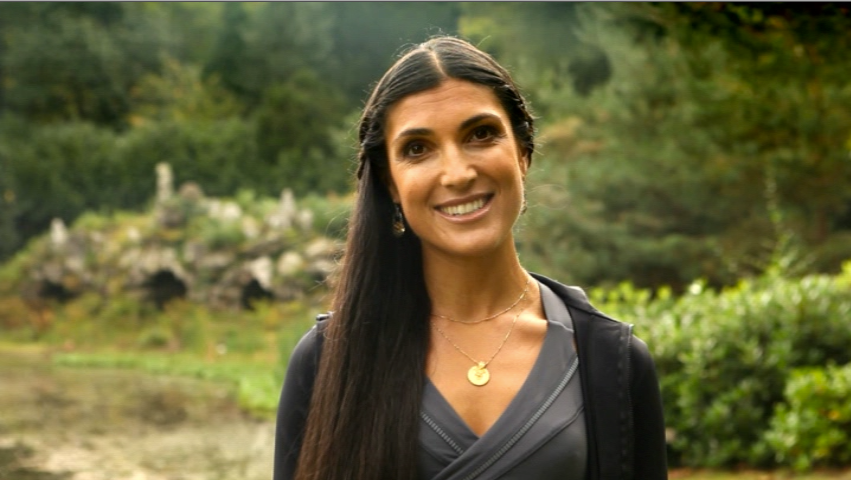
Tara Lee, yoga instructor

I tend not to get excited about the symbolic poetic effusions of yoga instructors, but I will say this. I worked with Earth Foundation after a period of no yoga at all. (Isn’t this always the case somehow?) I had been traveling a lot, my body was stiff, tired, inflexible… I wanted a yoga program that would stretch me out nicely without making me fall over. I wanted something that wouldn’t be too painful. In short, I wanted something forgiving. And this DVD hit the spot.
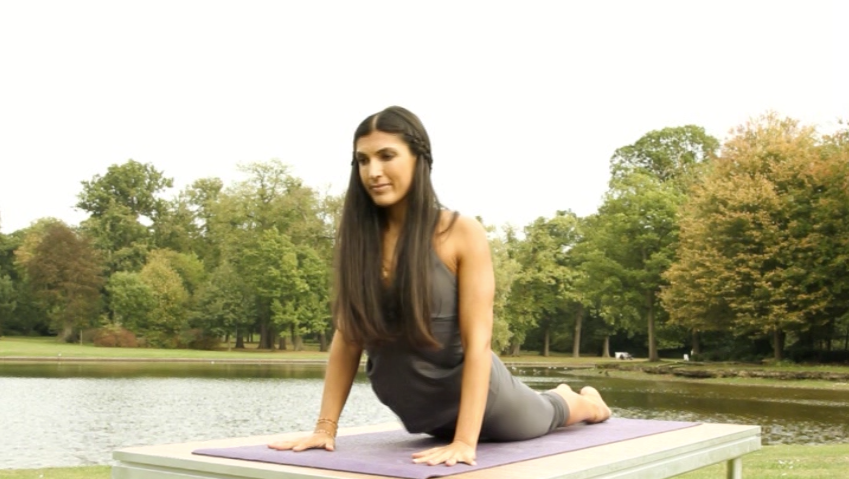
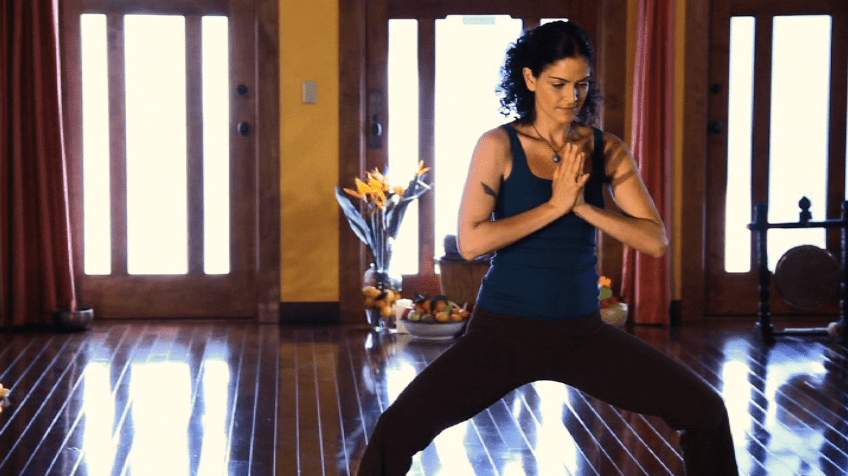
Tara Lee doing upward dog yoga position
What, did you expect blue skies and a tropical beach?

Earth Foundation is divided into three practices of about twenty minutes each, plus a 5-minute shavasana. In fact, the sections really build one well-constructed hour-long practice, though I guess you could do just one if you were pressed for time. Practice 1 starts out gently, with breathing to get centered, and continues with a series of slow, delicious dynamic stretches that get your body warmed up. Plenty of pauses in between too, with more breathing and relaxation. A number of the movements in this section were similar to exercises I know from Gary Kraftsow’s excellent Viniyoga programs, and since those have basically saved my back, I was inclined to trust the usefulness of this section. I may be getting you warmed up without too much trouble, but it also carefully strengthens the back muscles.
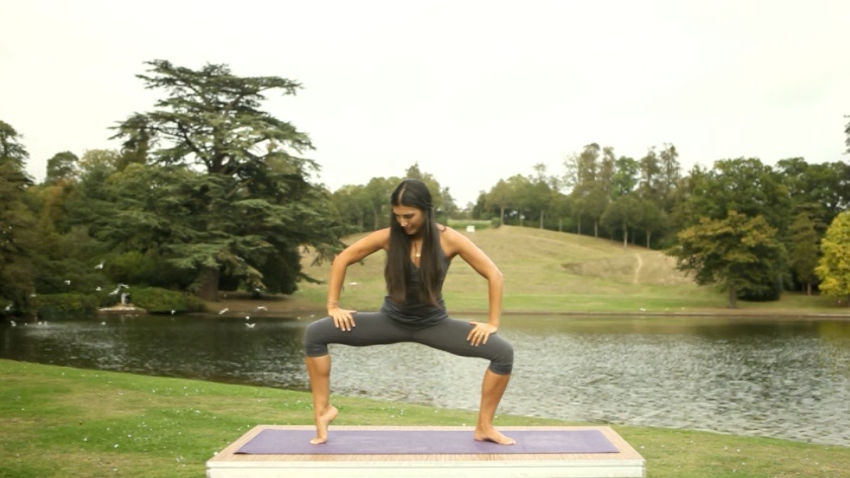
Tara Lee doing thigh work in her yoga DVD


Practice 2 begins with soft twists and forward bends, and moves into a long sun salutation. While it is not painfully challenging, I did feel myself working, getting warmer and even a bit tired. There are some deeper stretches like pigeon, and some delicious strength work. It’s all a bit more challenging, but still doable on a quiet evening. The third practice is more vinyasa flow, this time with warriors, triangles, and lunges. The latter part of this practice is another nice sequence of exercises and stretches for the back and hamstrings.

All in all, this is an approachable, but still satisfying, program. It’s marketed to beginners, and while you do need to know a bit about the poses, you don’t have to be in top shape to keep up. Nor do you need any uncanny flexibility. Someone very stiff could just do practice 1, and someone looking for a full workout should do the whole hour.

What I found particularly charming was the Englishness of it all. Tara has the accent of course, but even more delightfully, the “exotic” background is English countryside! It rather reminds me of a park I used to live near, and because it looks like a lot of places I’ve lived, it makes the yoga more approachable. I don’t get to practice yoga on a lot of Tahitian beaches, so why should I watch others do so?

The bonus features include three segments around ten minutes each: a more advanced balancing sequence for this “earth” program, along with a breathing segment for “air & water” and a difficult core workout for “fire.” I haven’t looked at the other DVDs, but I’m assuming they all have the same bonuses. Finally, there is a 17-minute interview with Tara, in which she describes how she found yoga and became a teacher. She also explains how her studies in shiatsu led her to focus on the elements, which became the basis of her DVD program. She comes across as thoughtful and intelligent. I should admit she really won me over with her description of yoga as a tool not only to deal with stress, but to get a sense of yourself as you, separate from the roles you inhabit in the world. Both yoga and dance do that for me (dance perhaps even more so), and it’s good to be reminded of how important that is.

I received a review copy of Beginners Yoga and Beyond: Elements of Yoga: Earth Foundation with Tara Lee.
IAMED essay contest for the near-win!

Dear readers, I thought I’d share a little something with you. I just got word that my entry to IAMED’s 2013 essay contest won second place. Woo hoo! I’m especially delighted by the generous prize of four DVDs, which I have been having a lot of fun choosing.

The prompt asked us to describe our favourite part of the bellydance routine, and I wrote about the drum solo:

This is how I started to fall for the drum solo. It can be fierce and tight, full of pops and locks, but it can also be cool and relaxed, with travel moves and big shimmies. And it’s the perfect do-it-yourself version of bellydance. You don’t need to have a lot of space for traveling moves, or the right floor for spins, or ceilings high enough to practice the veil. I can listen to a drum solo while waiting for the bus, and play with the rhythms under my winter coat. And even more exciting, you don’t need a full orchestra to enjoy dancing to live music. Find one drummer who is really into it, even if he or she hasn’t mastered all of Arabic or Turkish percussion, and you can have music and dance to it.

You can read the entire essay online here.

Review of Ruby Beh’s Pilates for Bellydancers

I’ve been traveling lately, and it hasn’t left much time for dance, or for any kind of working out. It’s pretty terrible, going from pretty regular movement to nothing. So tonight, after I put the kiddo to bed, I decided to try out Ruby Beh‘s newish instructional on RAQStv, Pilates for Belly Dancers. I wanted to dance, but even more, I wanted to give my abs a little attention.

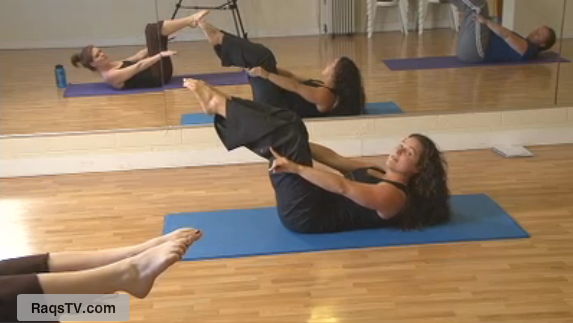
Ruby Beh showing pilates hundred

What I found is an answer to a lot of my dance problems of the past year. One of my challenges lately has been moving from the idea that bellydance is totally “loose” (I’m not really sure where I got this, except by some dumb opposition to ballet), and building up abdominal strength, learning how to keep my core engaged, and hardest of all, learning how to breathe with all of this. I don’t think there’s a single dance class I attend where the teacher is not constantly on me to keep my core “zipped up.”

Well, that’s what Pilates for Belly Dancers is all about. Ruby starts out slowly, really slowly, with posture and practice breathing both standing up and lying down. I loved the meticulous tiny movements that at least started giving me a sense of how the breathing and muscular contractions should feel. She then guides you through some classic pilates movements (the hundred, roll-ups, etc.) but interweaves exercises that help you gain control of the specific muscles useful for bellydance.

After a workout that is challenging if done attentively, Ruby has you practice some basic bellydance moves with special attention to the core. Finally, she teaches a short combination. In both of these segments, she explains what effects can be achieved with a strong, controlled pilates foundation — the fast spin that can stop on a dime, the quick-changing footwork that doesn’t make you bob up and down.

The video is 1 hour and ten minutes long. There was a brief but satisfying stretch to cool down with in the bonus content material, which also included the pilates section from Ruby’s Flawless Floorwork: The Lost Art of Belly Dance Floorwork DVD. The filming is clear throughout, though there is one blooper that was not edited out and a few camera cuts are confusing. Think filmed class, not pro DVD. Still, I had no problems following along.

In short, I was thrilled with the program. Ruby’s generous with pointers on form, and she will sometimes give modifications. She has the experienced instructor’s ability to know, magically, through the screen, just what I’m doing wrong and to correct it. She also has a knack for coming up with lots of illustrative similes to help conceptualize a movement.

All in all, it was so good for me to spend an hour really paying attention to what my core was doing at all times, how all other movements, whether exercise or dance, related to it and drew on its strength. Like Ranya Renee, Ruby talks about engaging the kegels too, though I haven’t heard this talked about in my classes. I haven’t been as delightfully concentrated during a pilates program in a long time. I wish I could buy this on DVD, but at least it’s being offered as a two-month rental on RAQStv.

Review of Sarah Zahab’s Postnatal Strength Workout

Before I get into the review, I just have to share: today is my son’s first birthday. This has been the most exhausting year of my life, but also an incredible one in many ways. About a week ago, he learned to walk unassisted, and so I’ve not only managed to keep a baby alive for a whole year, but he’s now a proper toddler!

It’s hard being a new mom. You know you ought to work out, but it’s tough. There’s the constant fatigue, there’s a needy baby who demands all of your attention just to stay alive, and it’s hard to decide what to do even when you have a few minutes.

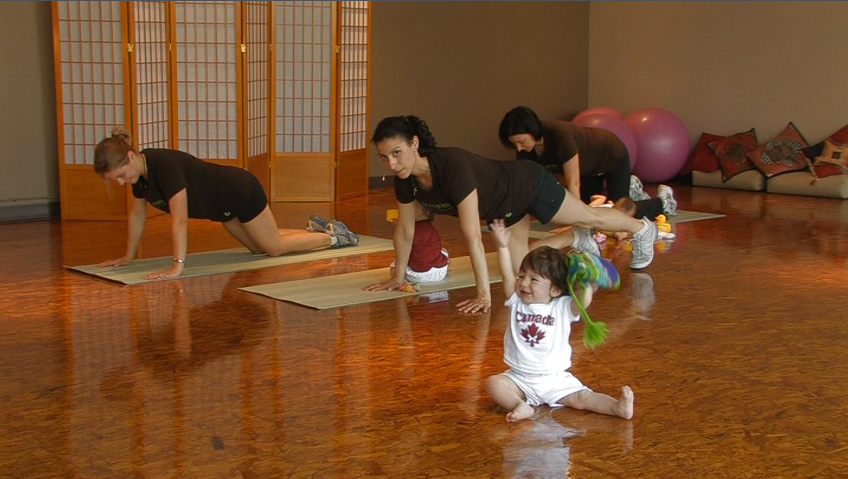
Sarah Zahab’s Postnatal Strength Workout aims to solve a lot of those problems by incorporating the baby into the workout. But you know what?

It’s also hard being a blogger, trying to decide on just the right screenshot, when there are so many adorable moments.

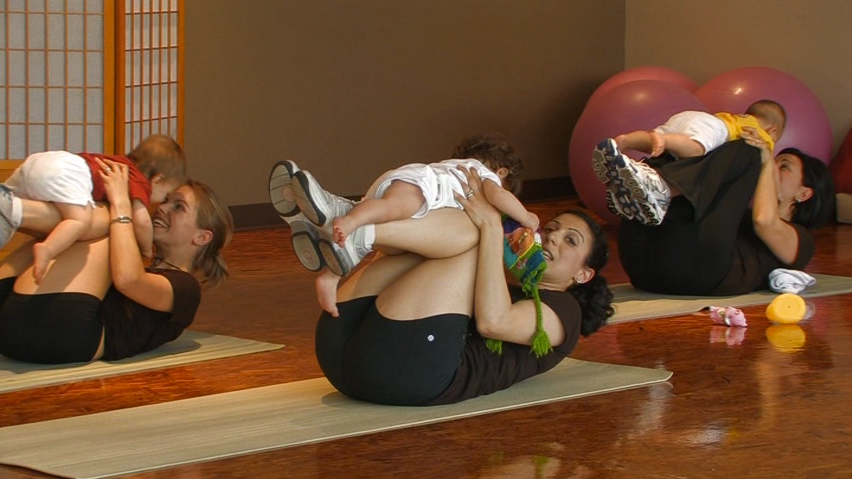
So, alright, I’ll settle on this one, a baby who has gone rogue, in a Canadian t-shirt (go, Canada), gleefully taking over the show. The Postnatal Strength Workout DVD (of which I received a review copy) is a totally professional, well conceived workout that is both doable for postpartum women and scalable for a greater challenge. But Sarah and the other people involved in the making of the video clearly also have a sense of fun. I think it’s a great idea to bring babies into the workout, but mine never, ever stays still. It made me incredibly happy that the babies in the video didn’t either, and it just made the whole program seem more approachable. “This is being a parent,” it seemed to suggest, “but you can still carry on with the pushups.”

So let’s get into the meat. After an introduction in which Sarah describes how and when to do the workout, you get seven sections:

Warmup (about 3 min): Sarah introduces her co-exercisers, who show easier modifications of the moves. There is posture instruction, stretches with breathing, and squats, and guided kegels.

Baby Workout 1 (about 3.5 min): This section is intended for babies of all ages. Most of what they have to do is hang out on the floor while the moms exercise, but the positions allow the moms to interact with the babies. Here there is a focus on gently but carefully working the abdominals, push ups, and planks.

Baby Workout 2 (about 5.5 min): For babies who have head control. This section has more creative use of the babies, since they actually serve as weights! Sarah gives tips on how to hold the babies (and how to react to them if they don’t go along with the program!), as well as giving frequent technique pointers. I really enjoyed the exercises here, including squats, press-ups, some really intense ab twists, and bridge. One of my favourites was a double crunch with the baby belly down on the knees. I love the fact that these moves could also be done in the middle of a day, when spending time with one’s kid. And, since my baby already weighed over 20 lbs when I did this section, it was some serious strength training!

Body Weight Workout (about 9 min): This section just uses your own body weight. However, I still had the baby around — he stayed for the whole workout — and that worked fine even if I occasionally had to run after him. It includes some well-guided low squats (these can really hurt my knees if I’m not careful about form), push-ups, shoulder squeezes, a variety of hip lifts and crunches, leg taps, and… more kegels!

Ball Workout (about 9 min): This was a super fun ball workout, and I have to say, even though I am no longer newly postpartum, it was enough of a challenge for me to feel a burn on this one. Again, this is also all about the abs, which is exactly what a new mother needs to work on rebuilding, but there are also exercises for the backs of the legs, arms, and of course, the kegels.

Stretch (about 6 min): Pretty classic set of stretches, including some really nice moves for the lower back. And, oh yeah, more kegels! I’m guessing Sarah thought kegels were boring and needed to be split up over the workout — a good idea of putting necessary pauses to good use.

Bonus (about 5 min): After a check for diastasis recti, or abdominal separation, Sarah guides a few exercises for building abdominal strength that are safe to do in the first six to eight weeks after giving birth. After this section, the video moves directly into a few outtakes and bloopers.

All in all, Sarah Zahab’s Postnatal Strength Workout is a useful program you can do in bits (this is why I included rough times) or all together for a longer, but still manageable workout. Zahab suggests that if you want a greater challenge, you can repeat sections, which I probably will when I do the video again. I like that she’s constantly keeping you on form, and that she’s aware of women who have had vaginal deliveries or c-sections. She also has a really warm on-camera presence, friendly and motivating without being annoyingly perky. (Well, and the occasional twinges of a Canadian accent remind me of home.) The one thing that worked less well for me was the camera angle, which sometimes made it difficult to see what the modified exercises were. This video would have been just the right amount of challenge for me about eight weeks after birth; a year later, the ball workout and the exercises using baby as weight still made me work.

You can get Postnatal Strength Workout at Amazon, or directly from Sarah Zahab at http://www.sarahzahab.ca/.

Veil and Drum Solo Workshops with Aisa Lafour, and other dance notes

My dear readers, I’ve been a busy dancer. I had an incredibly intense week about a month ago — lots of work, lots of kid, lots of dancing in the evenings, either in class or with a video or doing improv, and then on top of that, a super Saturday of workshops with Cihangir Gümüstürkmen. (I will write about this soon.)

Then I was tired. Just exhausted. I didn’t want to dance anymore, I took about a week and a half off. You know the feeling — not inspired, not motivated? I really just wanted to go home in the evenings and spend time with my family, and not be in the studio. I also felt a little sick. I thought, what’s wrong with going to bed ridiculously early for a while? (Answer: nothing. Nothing at all.)

I read my emails from Alia Thabit and Rosa Noreen, and felt guilty for not doing my improv or my Delicious Pauses homework.

I watched a bit of a few videos. Ranya Renee’s Baladi DVDs, and Autumn Ward’s Beautiful Technique. Listened to baladi songs while going about my business, and practiced taking apart the music. Realised that I have a ton of music, but not enough baladi. One night after work I wrote a little piece for the RAQStv essay contest. The prompt was to write about our practice, about how we fit dance into our lives. I wrote about how I try, but so, so often fail.

But you know what? Sometimes taking a break is good. I actually felt re-energized when I went back to classes. A few things clicked that I had been struggling with before. I won the RAQStv contest. And this past Saturday, I took part in two workshops with Aisa Lafour sponsored by Hayal Oriental Moves.

The first workshop was veil technique for beginners, along with a choreo to the gorgeous song “Yearning” by Raul Ferrando. I have very little experience of veil in class (or, well, anywhere else), so I was glad for the opportunity to do a workshop on veil that assumed nothing. Aisa had us start at the very beginning, walking back and forth with the veil, watching how it moves, and learning how to arc it up above us to get it behind or in front. Then we moved on to technique for a few traveling moves, and the rest of the technique was done in the course of the choreo. What I particularly appreciated — and want to remember — are the little performance details Aisa put in. Things like moving softly down as the veil falls, so as to mimic the veil’s movement with one’s own body. I adore these kinds of details, the refinements that make dance really beautiful and more than just a bunch of movements.

While this was all going on, I had Realization of the Day #1: bellydance, oriental dance, however you want to call it, is so ridiculously complex, involves so much training, attention to the tiniest muscle movements, practice with props, learning music, and yet most of the general public thinks it’s nothing more than hoochy mama butt grinding.

And then my veil got caught on one of the ceiling lamps.

The second workshop was a drum solo to “Drum On” by Ali Darwish. This was a really peppy, fun routine, with a number of different shimmies, some fast spins and travel accents, and a few cute Latin elements. I particularly enjoyed a funny butt shimmy Aisa described as coming from Brazilian dance, and which she called the “rabbit.”

It was above my level, but I love having a sense of what I might learn, review, try again work on. Here in Berlin, a lot of workshops are pretty explicitly geared to levels, which I’m not as used to from the US. There, people just went to workshops. On the one hand, it makes sense, since instructors can teach advanced material to advanced dancers. But I also think there’s a lot to be gained from doing workshops a bit above one’s level, since they give you an understanding of where you have to push yourself to get to.

Then I had Realization of the Day #2. Readers of this blog know I’m not a huge fan of learning choreos. I’m a slow learner, and I often get frustrated trying to remember and keep up with everyone else. But I realised on Saturday that learning choreos is not just about a certain approach to dance, or even about learning transitions. It’s also that certain moves are just not so likely to pop up in drilling or technique lessons, but somehow do make their way into choreo instruction. These might be transitions, or traveling steps, or stylizations, or they just might be somewhat lesser-used moves that the “home” instructor hasn’t covered yet.

Anyway, the point was, for once I found myself really enjoying the process of learning a choreo. Some parts of the song really clicked for me, others I had a lot of trouble with (and believe me, I know those are precisely the ones I need to practice!). But all in all, there were just a lot of really delicious movement combinations that were fun to do. And the more we rehearsed them, the sweatier we got, and the looser the muscles did too, so some of the passages also became easier to perform.

When we were working on a particularly tricky bit, Aisa mentioned that she’d had a hard time at first with the combo, and had to practice to get it. This kind of thing is so good to hear when you’re struggling to pick up a phrase. She then talked about how she often choreographs above her dance level, so as to challenge herself. I thought this was also a wonderful reason and way to do choreography. If improv is about finding your safety moves and working with them, why not choreograph to bring more moves into that repertoire?

So now, some classes, workshops, DVDs, and writing later, I am once again a happy dancer. And I know precisely what I need to work on.

And sometimes the universe tells you to dance

I try not to be too, too superstitious, but every now and then, the universe organizes its messages a little too neatly. Everywhere I turn I hear the same thing, and finally I start to think that maybe I should pay attention. Take breathing. Suddenly, everyone’s telling me to breathe! Alia Thabit, who tells me to prep for the 90 Day Dance Party by breathing in time to the music. Or I do Hala Khouri’s yoga DVD, and am struck by how much the breathing helps me unwind. Or my real life teachers are suddenly focusing much more on working with breath to create movement. Or I get an email from Rosa Noreen’s Delicious Pauses Online Intensive, and she’s going on about…. well, you can guess.

Okay, so I’ve figured out I should take a breath now and then. Maybe even when I’m moving. But another little synchronicity got my attention lately too. First, it came my way from Life is Cake, in the form of a video in which several dancers talk about the evolution of their style. What really hit me was Autumn Ward’s contribution, which you can see here.

Autumn talks about a period in her life when she worked on a number of skills she thought would impress a nightclub crowd, and how she wound up returning to her own passion for intricate, lyrical dance. I thought it was so honest and vulnerable for her to talk about moments gone wrong (or at least awry) in her artistic path, and also so inspiring. It’s so easy when doing creative work to get caught up in what we can’t do, what other people can, and so on. And often that can be positive — as Autumn points out, it can lead to acquiring new skills. But sometimes it’s also key to remember where your passion is, what your strength is, what’s authentic to yourself. And really, that’s where the greater part of the effort needs to go.

Then Alia posted a quote from Seth Godin on her Facebook wall:

The ability to say, “It’s not for you,” is the foundation for creating something brave and important. You can’t do your best work if you’re always trying to touch the untouchable, or entertain those that refuse to be entertained.

“It’s not for you.”

This is easy to say and incredibly difficult to do. You don’t have much choice, though, not if you want your work to matter.

Now, that’s pretty great stuff right there. I have no idea who this Seth Godin fellow is, but I’d buy him a cup of coffee if I saw him just because of that one blog post. What a wonderful line to keep in mind, not just for the living critics, but the imaginary critics who populate my head? “This is not for you, babe. Move on, there’s nothing to see here.”

Anyway, long story short, I put one and one together and figured the universe was telling me the following: first, however frustrated I sometimes get with myself in my dance classes, with the fact that I’m not further along than I really am, I needed to chill out, and also realise that at some point I’ll have to figure out what kind of dancing I most want to do, even if my skills and technique still have a lot of developing to do. And second, in my real life work, which is also creative, I needed to care a lot less about what people might think if I were to carry it out precisely as I want to. And that latter bit was much more important. Because in way, the dance world was telling me what I had to do at work.

The result? This week I finished an important chunk of a long project, and in fact, the hardest section so far — one I’ve been fighting with for more than a year. I rewarded myself by going to the wonderful local bellydance store, Saidi, and buying my first bedlah. It’s turquoise, so much louder and more revealing than what I went in looking for, and just unapologetically glittery. I’m a big believer in spending money on instruction and not on costuming, but in this case, I had earned it.

And my dance classes were filled with all sorts of little moments of joy. First, in ballet, having our teacher ask us to do a flat back, and actually getting it right. I have struggled with the flat back for ages, so having her come by, take a look at me, and say “it’s perfect” was like finishing a long hike. Or noticing that some of the armwork I did in the Aziza DVD was seeping its way into my bellydance class work. Or today, practicing those killer Soheir Zaki hips at home and finding that it actually made a difference when we drilled them.

Hmmmm…. I hear you wondering. Is there a moral to this long, rambling post? Basically:

1. Do what your passion tells you to do.
2. Enjoy small victories.
3. Try breathing once in a while.

Review of Hala Khouri’s Yoga for Stress Reduction

Every now and then, I quite simply fall in love with a DVD.

This happens to be one of those times.

Let’s just say I haven’t had the easiest time of it since becoming a mother. For all kinds of reasons, it’s been the most challenging period of my life.

I’ve worked with Hala Khouri’s Yoga for Stress Reduction: Simple Techniques to Manage and Release Stress a couple of times since getting a copy to review. It was hard to make the time for it, or rather, for myself, due to obvious reasons. But every time I did, I enjoyed it so much, for every single second, that I kept asking myself why I don’t do it more often. This should be my go-to yoga DVD. It may well become my go-to yoga DVD, at least for when I have about 70 minutes to devote to it.

Before I go into the chapter breakdown, let me list the things I like about this video:

  • It’s a flow, but it doesn’t move so fast that you don’t have time to find your stability or make sure your form is right. That tends to drive me nuts about flow-type yoga.
  • The focus is in fact on stability, on finding relaxation in a strong pose.
  • Hala incorporates faster and looser movements into the yoga practice, so there’s also a chance to get some nervous energy out.
  • Her voiceover is soothing, and inspirational. This kind of thing is such a fine line to tread, since the kinds of things that yoga teachers find motivational can sound a bit cheesy to the rest of us. But Hala walks the line well, and frankly, when you really are very stressed out, it’s nice to have the instructor remind you that it’s ok if you fall during a balance pose.
  • Good production values: Yoga for Stress Reduction is beautifully filmed, chaptered, all that stuff. The sound and image are clear. Though I found that by the second time around, I barely looked at the screen anymore — I just followed the instructions, often with my eyes closed.
  • Almost every single breath is cued with movement. Breath is central in this practice, and so good cueing is essential.
  • I slept like a baby last night after doing it.

Now to the contents. After a brief spoken intro, you have a Warm Up with a focus on deep breathing and basic, passive stretches for the back, legs, and shoulders. This 18-minute segment would be great on its own at the end of a long day.

Next is a 25-minute Standing Pose segment. You have a slow version of a sun salutation with a variety of standing poses worked into it. Then, facing forward, you do a straddle sit with arm movements — I found this delicious, building strength in the lower body and flexibility in the arms and torso. Finally, you move between balancing on the left leg and the right, also a really pleasurable way of practicing balance without getting bored or exhausted.

Shaking It Off is twelve minutes long, and you will either love it or hated. After some slow, tai chi-type moves, Hala has you “massage” different parts of your body with percussive hand movements. The second part is loose, energetic movement, in which you shake what your body needs shaken. I think the key to doing this section is being alone, closing your eyes, and really committing to looking ridiculous. I still don’t quite know what Hala does in this section, because I just don’t watch it. When I did this video, it really clicked with some of the online discussions I’ve had with Alia Thabit, mastermind of the 90 Day Dance Party Challenge. Alia sent me some literature by Peter Levine, who works to heal trauma by helping patients discharge nervous energy built up in the body (Somatic Experiencing). Touching the various body parts and shaking out the energy are two techniques I know, second hand, from Alia. Now, I am not a therapist, and I haven’t really evaluated the research too closely (though there is research on it). All I can tell is that it does feel good to do this kind of movement. I sometimes found myself moving into bellydance vocabulary, but I tried to shy away from it and just be really free and chaotic in this section. I didn’t want to feel like I was in the classroom! (A footnote: reading Hala’s online biography, I find that she’s trained in Somatic Experiencing. Makes sense!)

The physical part of the practice ends with a 15-minute Cool Down. This was probably my favourite part of Yoga for Stress Reduction. Hala leads you through forward bending poses, which always have a soothing effect on me. And shavasana to end, of course.

The video also includes two 5-minute meditation practices, but I have to confess I haven’t spent too much time with these!

The one fault I can find with Yoga for Stress Reduction is that the menu does not include minute counts for the individual segments. This is a small oversight, but I think I would have done the program more often if I could have seen at a glance how long I needed to commit. In fact, any of the yoga segments — including the warm up and cool down — would be great mini practice sessions too. I can imagine doing Shaking It Off during a particularly stressful day, or the Cool Down before going to bed. (This is why, incidentally, I’ve put all the info here!) The other thing you need to know is that Hala does not give really detailed basic instructions about how to do the poses. She gives good pointers, but it’s helpful if you are already familiar with basic asanas. I liked not having a lot of extra talking, since I already know to check where my weight is in mountain pose, for example.

Yoga for Stress Reduction is available at Amazon. You can also find out more about Hala Khouri at http://halakhouri.com/.

Review of Aziza’s Hands, Arms & Poses

Aziza’s oft-repeated wisdom is: “Be amazed.”

At one point while I was doing this video, I thought: “Dude, if I found my body doing what hers is doing, in the way that hers is doing it, I sure would be amazed!”

When you see the title of the DVD, namely Hands, Arms & Poses, you can be forgiven for thinking this video will give you ideas for things to do with your hands and arms while you dance. And it does. Aziza covers useful stretches for the hands, does drills to isolate your wrists, teaches lotus hands as well as beautiful positioning of the fingers. And while the arm work centers on the port de bras, there are good tips for moving with intention, and other arm pathways as well.

That said, I kept thinking the video (which I received as a review copy) should have been called something else. Because the real strength of this program is not in giving you a thousand hand or arm positions — it doesn’t — but in teaching coordination and control. And for that, you have some really fine drills.

After a quite dancey warmup of eight minutes, focusing on the arms especially, you have a variety of exercises. The section called “Drills & Exercises” with “Drills.” This 17-minute segment is a great standalone mini practice companion, the bulk of it being slow and steady arm flows layered on top of  rhythmic hip movements. This is the kind of thing that some instructors do have you practice early on (one of mine does), but not reliably, and it is challenging. When I did this section, I had to think that I should probably do it at least once a week. Seventeen minutes can’t be that hard, can it?

Aziza is looking to see if you’ve been doing your wrist isolations.

Next come two sections on foot patterns. In each, Aziza teaches a long combination, has you repeat it a few times in both directions, and then adds changing arm work to it. I’ve grown to love the teaching technique of drilling a combo with stylistic variations, and I think it’s a wonderful way to show what varying arms can do. The first combination is somewhat easier to get a handle on, while the second shows Aziza’s ballet training, and has rather more difficult leg work. Aziza doesn’t then explain every single arm moves, but you’re supposed to follow along and, probably, improvise a bit on your own.
The one thing that drove me absolutely nuts during this section is that once Aziza gets going with the arm stylizations, the camera focuses way too much on her lower body and feet. I found myself wanting to stick my hand through the screen and yank the view up to Aziza’s arms!

After some wrist isolations, we move on to the “Poses & Combinations” section. In a way, this is the hardest of all, though it looks the easiest if you’re just watching the video. There are three combinations of, well, poses, but the trick is that you’re supposed to move with incredible control from one to the next. Imagine a crazy hard tai chi. When I posted about doing Hands, Arms & Poses on Facebook, Lauren Zehara confirmed my suspicion that this is truly hard, but worthwhile, dance practice:

It’s very different from what most dancers study in their regular weekly classes. Aziza is assuming that we can do all the basics (hipwork, etc) and challenging us to do that while holding exquisite lines in the body and moving with grace and intention. THAT is challenging at any level, and great stuff to work on!

Why do this kind of work? I think if I’d run across this material a few years ago, I would have thought it pointless and boring. But in the meantime, I’ve worked with Rosa Noreen’s Delicious Pauses, and I took a workshop with Heather Wayman in which she shared some of Nadira Jamal’s tricks for using poses to structure improv. Both Rosa and Nadira are well aware of Aziza’s work, I know, but through them I was prepped to see the value of this. It is very hard to slow down the way Aziza practices here, and to keep looking good. I found myself naturally checking in on my abs, to see if they were pulled in, because I needed that muscular support to control my movements. And, while I wouldn’t do all of the poses, a lot of them were quite beautiful and pleasurable. It became, dare I say it, almost meditative to repeat them with intention.

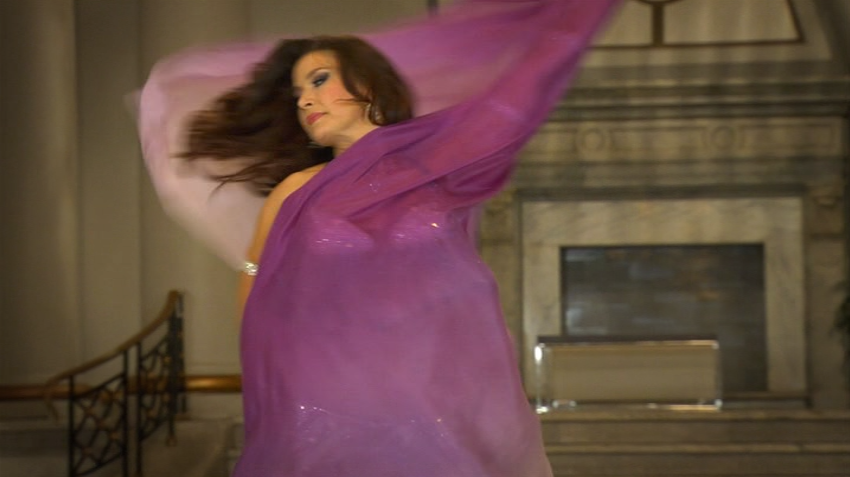
After a brief, also dance-based cool down, you’re done. But you’re actually not done. Hands, Arms & Poses includes three performances. One incorporates the movements into an actual dance, another offers a dance with veil, and a third is “vintage Aziza” in a powerhouse performance from 1994. Other extras include photos of Aziza as a young ballet student and beginning bellydancer, and an interview.

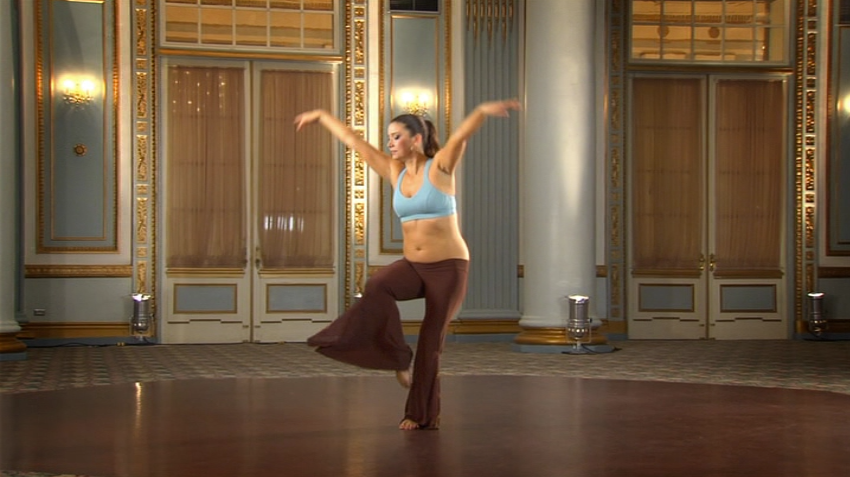
Production values are very high. The quality of the film is extremely good, and the video itself is shot in Le Windsor, a nineteenth-century Montréal hotel. Aziza uses real music, from Hollywood Music Center, track information is given, and the music is in time to the exercises, not just a vague backdrop. The one thing I wasn’t fond of was the fascination with the feet in the foot patterns (!), but in other sections of the video the camera knew where to look. This is a gorgeous video, and one I will return to again.

You can get Hands, Arms & Poses at Amazon or via Aziza’s website.


Roundup: How (and why) to learn bellydance online for free – Updated

We all know (well, most of us) that the best way to learn to dance is with a live teacher. And there really is no substitute for someone who can guide you in person. But there are some good reasons to use video instruction, and the free dance resources I mention below are perfect for this kind of thing:

1. You want to review a move you learned in class.

2. You didn’t understand your teacher’s explanation, and want to see how another dancer introduces the movement or idea.

3. You want to drill movements, and you’d like some guidance as you do so.

4. You need some inspiration, something fresh to make dance exciting.

5. You don’t have a lot of time, and you just want to incorporate five or ten minutes of dance into your day, maybe even in the office!

6. You’re on the go, and want to watch someone teach a move on your phone or mobile device.

Now, there are some truly bad teachers offering their “services” for free online, and every now and then one of those videos makes the rounds. But the truth is that there is also some good instruction out there. None of these will replace live teaching, and in most cases the free stuff isn’t even as comprehensive as DVDs or longer structured instruction. They can, however, make a wonderful adjunct to your regular classes.

Totally Free, but High Quality Instruction Online

Tiazza Rose: Amazing, amazing, amazing treasure trove of videos. Not only does Tiazza go over many basic movements, but she also has videos featuring veil moves, cane, folkloric moves, about a million small combinations and some longer choreos.

Mahin’s Daily Bellydance Quickies: You have to sign up for the Daily Quickies email list. What you get is not basic instruction, but a potpourri of little daily hints, tips, and lessons in your inbox. One day it’ll be an email with ideas on how to keep your drilling fresh, another day it will be a stretch useful for dancers, and yet another day you’ll get a combination to do with a particular rhythm.

My Bellydance Workout: Coco of Berlin has a variety of basic movement lessons and really useful drills. Everything is filmed clearly in a bright studio.

Bellydance Boulevard: The website connected to this YouTube account is defunct, and I suspect the videos aren’t being updated anymore. But what’s there is really neat. First there is a series of videos on basic bellydance moves taught by a single instructor. Then follows a variety of focused mini-workshops by a variety of teachers around the world. You want Soheir Zaki hips? Here they are!

So, what about you? Have you used any of these programs? Is there a wonderful secret source of free online bellydance teaching I’ve missed?

Update:

Reader LadyDeyrdre adds a few more useful contributions, and in looking them up I am reminded (how could I forget?) that Neon also has a series of quickie bellydance move instruction videos on YouTube. So, the additions:

Anthea Kawakib: A short playlist of basic zill instruction on YouTube.

Neon: At latest count forty-two videos, going from basics to traveling moves.

Irina Akulenko: Also a pretty solid series of beginner instructional videos, with some good tips. These are on the Howcast website, but are also available on YouTube.

Review of Samra’s Shimmyrobics

There’s a bit of a story to this review. A long time ago, in a bookstore far, far away, I found a DVD in the discount section called Belly Dance – Total Workout For Body Shaping (don’t buy from this link, but do read the comments!) It was three bucks, it didn’t look too promising, but I am a bellydance DVD addict and can not let anything go by. There’s always something to be learned.

When I got home and popped it in, however, I realised that the woman in the video had nothing to do with the woman on the cover of the case. In fact, even weirder was the fact that the video itself was a rhythm instructional, not a workout at all!

Part of the situation is explained on the Amazon page by Samra herself. The video is basically a copy of her video “101 Shimmies Volume 2,” sold under a deceiving cover and title by an unethical distributor. It’s not a workout, and in fact her attention was for the video material to be combined with instruction from her other DVDs. Someone just using this will be rather surprised by the lack of any basic teaching of moves. What’s more, she doesn’t receive any royalties from sales of the video. From our correspondence, it seemed she was even more upset that a confusing, poorly-branded video was out under her name.

I thought part of what I could do is work with the actual videos, and see what they have to offer. Now, these are old school videos. Samra herself told me that the production company was a small town affair, and this is true. The editing, production, music cueing, is all far from glossy or smooth. But what is actually in the content?

I’ve worked with Shimmyrobics twice so far, and in two rather different ways. The first time, I did the video all the way through, albeit in pieces. It’s almost two hours of material, beginning with a one-hour instructional section. What follows is a short, but pretty thorough warmup, five workout combinations, a cool down, and an advanced workout which is the five combinations strung together. When I first worked with the video, I was a bit annoyed that the warmup came after the instruction, although the chaptering certainly allows you to click on the warmup first. However, the second time I did the video, I just did the workout, and in that case, it was easy just to click on warmup and stay with the program until the end.

The instructional section has a ton of material. Even though I’ve seen a lot of it taught in other places, there were some new moves or combinations of moves for me, and also certain moves where the description was particularly enlightening. I still have to work on my choo-choo shimmy, for example, but Samra’s explanation of it is one of the most helpful that I’ve found so far. She also includes some moves from her other dance influences, like a backwards African shimmy and an African stylization of the chest shimmy. (In fact, these were some of my favourites in the workout!) Samra’s descriptions are detailed, and often include pointers on safety. The full run-down:

Head: forward and back; side-circle tilt.
Shoulders: lifts and drops; rolls; thrusts; quiver and shimmy.
Ribcage: slide, shimmy, circle.
Abdomen: pops – in, out.
Knees: side, flex, moderately straight, circle.
Feet: point/flex, circle.
Hands: close/open, shimmy, palms up or down.
Hip slide shimmy
Muscle shimmy
Jello/Fellahi
Freezes and Vibration
Knee Shimmy
Walking Shimmy
Hip Patterns (various hip bumps, lifts, and drops)
Hip Circles
Hip Bumps
Walking Hip Lifts and Drops (the latter a little like the Soheir Zaki step)
Running Choo-Choo
African Choo-Choo
Omi Circle

The workout has five combinations. For each combo, Samra does the steps individually and drills them for a while, then strings them together and repeats them in four directions. Rinse, repeat. After the first teaching of a combo, on-screen text lists the moves. I liked some of the combinations more than others, but taken together, they really did get my heart rate up, and even gave me a bit of next-day burn!

Two things I wasn’t as excited about were the repetition of combos in the four directions, and the fact that the music accompanying the workout is just a basic rhythm, without a real connection to the moves. I later read on Samra’s website that the latter was intentional, and that she expects students to use the moves with their own music. Accordingly, the second time I did the workout, I had my trusty mp3 player ready with my iPod in. I started pausing the video between the combos, putting on some really danceable pop (Natacha Atlas, if you must know), and practiced the combos to the music. And I did not stick to the four cardinal directions. Instead, I took the moves from the combo, changed up the number of times, the order, and did the traveling moves in a variety of directions and floor shapes. It became really fun, and a chance for a bit of structured improvisation!

The verdict? If you want something really smoothly produced, this is not the video for you. However, there is so much info on it, that beginning dancers especially are likely to find something new or useful. And the workout really is a workout. If you’re willing to play with the video creatively to make it part of your own practice, you will enjoy it.

You can get Shimmyrobics at Samra’s website, www.samrasexpressions.com. (Don’t buy it from Amazon under the fake name!)