Some tried and tested free yoga for your back and legs – David Procyshyn’s Deep Release

I knew I’d have hard decisions to make as a mother: breast or bottle, organic cotton nappies or disposable, constant ravaging guilt or just occasional intense bouts of it…. no, seriously, most of these were pretty easy. But what has been hard is this decision:

It’s late.

I’m tired.

But I also lugged around a toddler today and my back hurts.

If I go to bed now, I’ll get much-needed sleep.

But then my back might be worse tomorrow.

Yoga/stretching or sleep?

Usually I choose sleep, it’s just the most basic necessity, possibly even a little more important than air. But yesterday I chose yoga, and man was I glad I did. What I found was a one-hour program for the back and hamstrings that I thought would be just the thing for my tense lower back:

So, the first thing I loved about this is that it’s all sitting. I wanted something relaxing, and I was too tired to get up. I really just wanted to sit and stretch. The other thing is that other calming yoga programs I do often have pretty expected and easy asanas, so I tend to think that I could have just done the practice on my own. This program had a number of positions I’m not so familiar with, and with some measure of challenge. It gave me really deep, delicious stretches, exactly where I needed it to stop the pain in its tracks. Twists, forward bends, more twists, all done slowly and gently and with breath.

The other thing I really liked? David Procyshyn gives an instruction a few moments before doing it on screen, not at the same time. So you have time to process what he says, prepare to do it, and then do it along with him. It took me a bit to figure this out, but once I did I loved it — I wish all yoga instructors would do this. I never had the feeling I had to catch up to what was going on on screen.

Anyway, it’s free, go do it if you have back pain like me — it’s just an hour of your life. I for one loved it so much I will be checking out David’s other online videos.

Mistakes to avoid when producing a dance or exercise DVD

Maybe you’re producing your very first video, maybe it’s your fiftieth. Chances are, you’re going to make some mistakes… mistakes that have been made before by other people, and that you could have avoided. Mistakes that will lead either to customers ignoring your DVD, or to them being unhappy with it.

Wouldn’t you like to make a DVD that your customers will buy, and then be so satisfied with they’ll leave positive reviews online and recommend it to their friends? In writing this blog, I’ve looked at a lot of videos, and I see the same problems come up. I sometimes wonder why producers don’t think of these things, but I suspect it’s because those of us who use dance and workout videos have a different perspective on them than the people who make them.

This checklist is primarily intended for producers of dance DVDs, but quite a few of the tips apply to general workout videos too.

Content

Quality and Length of Content

Think about what you have to offer: are you covering ground that’s already been covered by a million other videos, or do you have something new to offer? Do your research, whether on Amazon, or by reading reviews in blogs and magazines. Moreover, do you have enough content? I’ve loved some shorter DVDs because they had a unique approach or taught me something truly new, but there is a line below which it’s not really decent to ask someone to pay full price for a DVD. Don’t count performances or non-instructional extras when you figure out what you’re offering.

Content in DVD Sets

If you’re putting out multiple videos, make sure the overlap between them is minimal, so your most loyal customers — those buying more than one — will not feel ripped off. If the sets build on each other, make it easy to see that. If they work independently, make it easy to figure that out too.

Skill

Your technique should be perfect. This should go without saying, but alas, it doesn’t. If you don’t have amazing technique, you probably should not be demonstrating moves for instruction on a video. In a class environment, you can correct mistakes you see even if you still haven’t mastered the move, but with a video you can’t. And if you have special knowledge you want to share, either make a lecture video, or get someone with better technique to do the demos. But here’s another thing: if you choose to have backup dancers/yoginis/etc. doing the moves with you, make sure their moves are also carried out exquisitely, even if they’re modified for difficulty. We learn what we see, and if we see you do bad technique, we’ll absorb just that.

Guidance

Don’t leave your students in the lurch — give them some advice about how to use the video, what they need to make it work, how to plan their practice sessions. This is especially true if you have a lot of material, if it’s especially difficult, or if you’ve made a complicated DVD menu. This is also an opportunity for you to teach them how you approach practice, which is often just as valuable as technique.

Warmup and Cool Down

People disagree on this one — not everyone thinks there needs to be a warmup and cool down on every video. I get that. But I will say that I think it’s pretty great if there is one, and if it’s easy for me to press “play” and get a full practice session, with warmup, instruction and/or drills, and cool down.

Space and Supplies

Imagine yourself buying your video, and trying to use it. What does it require? Does someone need lots of special props and supplies to do it? You’re probably filming in a studio — are you doing large traveling moves that someone might not be able to do in a small living or rec room? I’ve often seen cardio workout videos that require you to cover lots of room, which is possible in a gym, but difficult in the space I’ve cleared out in my living room. What about flooring? If you have a lot of spins or moves on the floor, have you thought about the fact that your audience’s practice space might be carpeted? It doesn’t mean you can’t include them, it just means you have to deal with that issue, either by suggesting a hardwood floor, or by providing a variation of the move.

Music

Please, please make sure your movements match the music. This is as true for exercise videos as it is for dance instructionals. It’s just that much easier to follow along if everything is in time. And if you’re teaching dance, dancing to the music is something you’re also teaching whether you address is explicitly or not, so make sure that part of things is perfect. Perfect.

More Music

If you’re teaching a choreography, please for the love of God choose music that’s currently available, and ideally, available without too much effort. Your customers should not have to order a CD from abroad to get the track — try to choose things they are likely to be able to buy online, or at least in the same country. Then provide credits, so your customers can find that music easily. If you’ve cut the track to make it fit the choreography, then give your customers easy-to-follow instructions to edit the track, or make it possible somehow for them to get a legal edited version.

Mirroring

I think of this as the mark of the pro. Either film yourself (or the talent) facing the audience, but move your left arm when you say “right” so they can follow along, or film yourself from the back facing a mirror. Bonus points if you’re teaching dance for showing a move both from the front and the back, and drilling it both ways.

Formatting and Production

DVD chaptering

The first rule is to do DVD chaptering, unless you really just mean for the program to be done as a single workout or practice session. But even better is sitting down and thinking about how someone might use the DVD the first time around, and how they might use it a second, or tenth time. Make it easy to skip the introductory bits. Make it easy to do all the drills without the instruction. If you can provide different built-in programs so they can choose a short version or a long one, even better. I’ve even seen dancers include different angles of the same program.

More chaptering

Have frequent chapters, it makes it easier for us to repeat a section. Put all of them in the menu, or in submenus, so we can get to them easily.

Timing

Write down the exact length of each section/program/workout both on the DVD cover and in the menu. Make it easy for people to see if they have time to do the DVD, or if they can fit one section of it into their day. Make sure this timing is accurate — on many DVDs I see it’s not.

Visibility

Ahem, cough, cough. If you’re wearing green, don’t film yourself against a green background. If you’re wearing black, don’t film yourself against black curtains. I’ve seen both of these, from dancers I adore. Again, this is a matter of putting yourself in the customer’s shoes. Maybe she has weird lighting in her practice room, or is using a laptop that doesn’t show contrasts as well from a distance. Maybe she’s using a projector, and the contrasts are also not that strong. Maybe she’s taken off her glasses, and can still see pretty well without them, but not every detail. (Maybe all of these examples are from my own experience…) Make it easy on her eyes, please. In fact, I’m going to go out on a limb and say that while I think black backgrounds look cool and modern up close, they should be avoided for the home video market altogether. Put your dancer against a bright, light background, either a studio or plain white, and have them wear clothes that make movements easy to see.

More Visibility

Camerapersons are wild creatures, and need to be led with a firm hand, lest they go astray. You’re teaching a choreography, and there they go focusing just on your abdomen. You’re demonstrating hands, and suddenly the camera is pointing at your feet. Did he get tired? Did his head and arms droop and bring the camera downwards? I don’t know. But look, during this complicated traveling move, suddenly the camera has become intensely interested in your facial expression! Discipline your cameraman — or woman — and make sure that camera is pointing where it needs to at every single moment.

Marketing

Trailer

If you have enough time to make a video, you have enough time to make a trailer for it, and make it widely and easily available. Put it on your site, put it on YouTube and on Amazon. Oh, and in the trailer, I don’t want to see you dancing or see shots of you looking pretty — what I want is to get a sense of what material is covered by the video and see a clip of how you teach or demonstrate. This should be the substance of the trailer, not the performance or your general thoughts on the dance, because the instruction is what I’m going to love or hate when I use the video.

Title

Make sure the name of your DVD really fits what it offers. Don’t call it a beginner DVD when the moves are advanced, or when you only have a very fast breakdown of them. Save the word “beginner” for people who have never done whatever it is you’re teaching in their entire lives, ever, and are now standing in their sweat pants in front of their tv learning their first steps from you. Use “advanced beginner,” “intermediate,” etc., as appropriate, if you’re expecting a bit of background.

Promises

Don’t make BS promises. Look, I know maybe it’s good business sometimes to make them, but please, just for me, don’t. Don’t tell your customers they’ll lose weight doing your program when they almost certainly won’t. Don’t promise them enlightenment or goddess-hood, unless you can guarantee it. Don’t tell them they’ll be a perfect dancer after one DVD. Because you know what will happen? They’ll find out that you were lying, and will leave unhappy comments all over the internets. Maybe you were offering something of value, but you misrepresented it, and so you didn’t do your own work justice either. You can promise them fun, you can promise them a new experience, or quality instruction, or a great tool to use in their practice. You can promise them relaxation, and you can even say, “if you do this x number of times a week, and pay attention to your diet, you’ll have positive results.” You can promise them a challenge. But be honest.

Your Thoughts?

Consumers of dance and workout DVDs, have I missed any big mistakes? What do you wish producers knew?
Producers and artists, what are the big mistakes you learned from? Anything here you disagree with? What do you wish customers knew?

photo credit: GS+ via photopin cc

Review of Sara Beaman’s Fluid Transitions: Drills and Combinations for Fusion Bellydance

If you’ve been dancing for a while you know: the right teacher is not necessarily the one who’s the most famous, the most experienced, or even, frankly, the best dancer. Often, it’s the person who can communicate to you in a way that makes sense to your brain and ultimately your body. This is important in live instruction, but essential when it comes to DVDs, where you can’t ask the teacher any questions, and she can’t respond to the way you learn.

This is why I get excited — really excited — when I see instructional DVDs that are crafted to work for different kinds of learners, that are more than just, “You do this, then you do this.” One of the exciting things about being a consumer of bellydance videos over the past decade has been seeing how creative producers get, with practice flows, the smart chaptering, innovative material and drills, you name it.

So, guess what? I was excited to work with my review copy of Sara Beaman’s Fluid Transitions: Drills and Combinations for Fusion Bellydance. From the first moment I thought, “Oh, she’s thought about this. She’s thought about how to make this usable and easy to learn from.” And my first impression was not wrong.

The focus of Fluid Transitions is pretty clear from the title, but it’s probably worth mentioning that Beaman does not give any theory or tips on transitions separately from the drills. The idea behind the program is to achieve fluidity by doing careful drills of combinations at multiple speeds. The DVD is aimed towards intermediate or advanced dancers — definitely not beginners! — and if you are one of these dancers chances are that you can take the tools Beaman gives you and apply them to whatever combinations you’re working on.

The most straightfoward way to work with the DVD is to play all the sections through, which is what I did. This way, you get a:

Warm Up of approximately 10 min. This is based on dynamic stretches and some shimmying, it starts up the muscles and joints you need to move, but it doesn’t get you really warm. I think it wouldn’t be a bad idea to do a little something extra to get the heart rate up too.

Isolation Drills, about 16 min. You can play this section right through, or choose single drills from a menu. Here, Beaman quickly but precisely covers the movements she’ll be using in the later combos. The drilling is brief — this is not mean to teach beginners how to do the moves, but to remind you of the correct executions of moves you already know. That said, Beaman also gives little tips on form.

Here’s one of the neat things about the DVD: each move is preceded by a screen that shows a written breakdown of the move. Being someone who learns best by reading, I loved this decision. It lets me internalise the idea visually, before I hear the oral breakdown and see how it’s done.

Sara Beaman tribal fusion DVD isolation breakdown screen
Breakdown of a sidewinder

This is followed by a brief, about 6 min, Isolation Practice Flow. You basically do the isolations, but all together. I think this part is great, as it gets you into the feeling of moving and putting isolations together.

Now we get into the meat. The first combination section contains combos 1 through 4 (about 30 min). Each combination has that great screen before it, quickly explaining what will come up. Then Beaman breaks it down veeeery slowly. As far as I could tell, for every single combo in the program, Beaman is equally thorough in breaking down and drilling both sides. It’s not only great to have both sides worked out equally, but I found that sometimes I will “get” a movement on one side faster than the other, so I’m glad to have both sides instructed too.

The combos themselves are quite short and focused on linking together moves using the torso, hips, abs, and arms. There are no traveling steps. These are small units you then drill like crazy to get your body moving smoothly from one kind of isolation to another. In some cases, Beaman will present an easier version and a tougher version of a combo — and then she has you drill both.

Just in case that wasn’t enough, she then has you drill the combos at three different speeds.  Often, she will have you drill something at half time and at full time for each of the three speeds, which means you’re actually drilling at six different speeds! All of the speeds and instructions segments are chaptered, so you can easily repeat, and they’re in the menus, so you can go directly where you like.

Needless to say, what this does to your body feels pretty wonderful. As much as it’s challenging for the brain to follow along, it’s such a fabulous, careful, thorough way of getting moves into your body. Even on the first play of the DVD, I was starting to “get” some of the combinations quite smoothly. I stopped and went to a mirror to practice sometimes, I did my own stretches in between the sections, but it all worked. It felt good. And I think doing the three speeds is brilliant, because while my first challenge was getting a combo down, my second was doing it slowly. Doing a combination slowly but still evenly and smoothly is harder than doing it fast, and a great way to pay attention to what the muscles are doing and to each component of the movement.

Then things get even more interesting. Beaman takes apart combos 1 and 2, and puts them together into one longer combo. Same for 3 and 4. And you drill those. Here’s what I loved about this. While she doesn’t say it in so many words, she’s really teaching you how to get smooth transitions in your own movement. You break it down into the smallest possible combinations, drill those like crazy, then combine them in creative ways, and drill those together.

The next section features combos 5 and 6 (about 17 min), and these work a little differently. These are layering combinations, and what Beaman eventually has you do is to do one of the layers, then all of the layers together, then another of the layers alone, then all together, and so on. What part of my brain was still working at this point was fried by these drills, but I also found them really cool. It’s basically a pattern for creating movement that’s interesting to the eye, adding and subtracting layers in turn.

Sara Beaman tribal fusion DVD layered combination with sidewinder
Drilling different parts of a layered sidewinder

Finally, you have a satisfying Cool Down that stretches everything out from a standing position. It’s about 6 minutes long, so I added some of my own stretches too.

The menus are really smart, really detailed. I love this, I love it when a producer really thinks about how to make the work usable. Moreover, in a separate section Beaman has four practices set up ranging from 23 to 32 minutes, each of which begins with the warm up, takes you through some of the combos, and ends with the cool down.

Fluid Transitions really, really, badly made me want to do more tribal fusion. But I don’t think you have to be a tribal dancer to get a lot out of it. This morning I was already thinking about how some of the combos could be modified — with something as simple as a heel up, for example — to give them a more raks sharki feeling. One thing I can’t judge however is how much of the material or method would be new to dancers already steeped in TF. Who wouldn’t like it? Well, if you’re a beginner, you might find it moves too fast for you. Also, if you’re looking for transitions between traveling moves, you’ll find nothing here.

That said, there’s a lot to grow with Fluid Transitions. She gives some tips at the beginning for how to modify or add to the drills. But the real point is, this DVD doesn’t just teach you to string together a few moves, it teaches you how to think about putting moves together and then drilling them. You learn to take out an element from an isolation to make it work with another move, you learn to take combinations apart and put them together in creative ways, and you learn how to play with layers to make cool-looking dance. What’s not to love about that?

Fluid Transitions is available as a print-on-demand DVD from Amazon. It worked flawlessly on my MacBook Pro.

Roundup: Bellydance Floorwork

Readers, I’m starting a new series in the blog. It’s something I’ve wanted to do in a while: posts that give a list of videos for a particular dance specialty, be it a prop or a dance style, along with where to buy them.

I kept thinking I had to do reviews of all the DVDs in a certain area before I could publish a list, but let’s face it, that will take some time. So I thought: why not come up with the lists first, and then link to reviews as I write them?

In addition, just to make the resource more useful, I’ll add any interesting or useful articles I find on the topic.

One more thing: I really welcome reader suggestions. Please add any videos I’ve missed in the comments, and I’ll update the posts on a regular basis! These posts are meant to grow with time.

Bellydance Floorwork Videos

Ruby’s Flawless Floorwork: The Lost Art of Belly Dance Floorwork.

Anaheed’s Classic Cabaret Floor Work

Tanna Valentine’s Floorwork: Bellydance for Body Shaping

Sarah Skinner’s The Celebration Bellydance Workout: Mood-Lifting Bellydance Flow & Workout (one of the workout sections is floor work, and some of the instructions are specific for floor work)

Fat Chance Belly Dance’s Tribal Basics, Vol. 8: FloorWork

Saqra’s Floor Dancing Technique

Rachel Brice’s Laybacks, Drops, Zippers & Floorwork (parts of this video rental are useful for floorwork)

Veda Sereem’s Floor Work

Cory Zamora’s Cabaret Bellydancing Floor Moves Advice

Delilah’s BellyDance Workshop Volume III

Articles on Floorwork

Shems’ Floor Work in Oriental Dance (history and cultural context)

Nita’s blog post, “bellydance floorwork & Purvottanasana: upward plank pose“(on using yoga to build strength for floorwork)

Morocco’s essay Getting Down to Floorwork (also historical and cultural context)


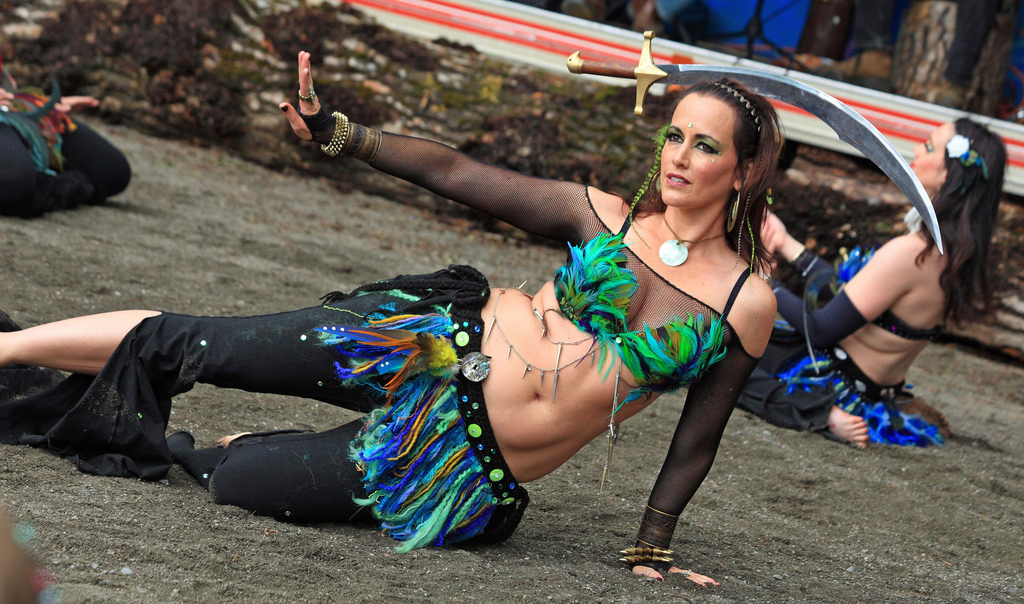
photo credit: Alaskan Dude via photopin cc

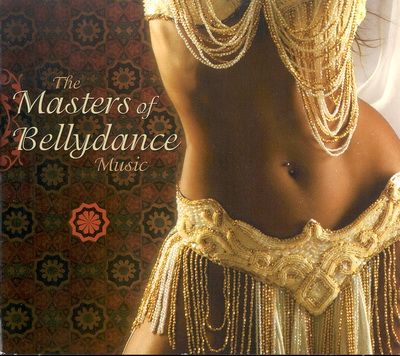
Review of Masters of Bellydance Music

Dear readers, this is my very first CD review, so I decided to make it easy on myself.

Masters of Bellydance Music is a ridiculously good, one-great-song-after-another, endlessly listenable album.

See? That was easy.

Okay, I guess you probably want to hear a little more. Masters of Bellydance Music is a compilation of fourteen tracks with a predominantly Egyptian, raqs sharki focus. The collection includes classics such as Tamr Henna, Aziza, and Enta Omri. It also brings in some folk flavour with songs like Souher Zaki Fi Balady and Fatme Serhan’s Ala Warag Il Foull on the balady end of things, and Saidi Party and Afrah Al Said for when you want to get your cane out.

What really gets me about this album is the quality of the recordings. The music is played with real instruments, and the sound is so clear and crisp that you can hear every single note and trill. Everything sounds like it was recorded yesterday, and ready for your performance tomorrow.

Most important though is the richness of the music. I have had my copy of Masters of Bellydance Music since 2007, and have listened to it many times. Most of the time I listened to it passively, waiting for a bus or dancing around my apartment — it’s impossible to hear these songs without wanting to move. But when I’ve also listened more actively I noticed that so many of the songs are interesting. They are the exact opposite of one-rhythm pop music, and they do not get old no matter how many times I listen to them.

The only thing that’s difficult about picking an album I like this much to do my first review is that I have a hard time picking my favourite tracks. Layali Al Sharq is up there, as is the album opener Rakasni Ya Habibi. Raks El Sheik grows on me more and more as I listen to it. But there’s not a single one I’d want to skip! Instead, I’m looking up the artists to find out what else I can get by them.

You can get Masters of Bellydance Music at Amazon, or direct from the producer at Hollywood Music Center.

(Full disclosure: I thought this was a review copy as I was writing this review, and kept thinking, “yes, this is a review copy, but I would have been glad to spend the money.” Then I saw on Amazon that I bought the CD myself, ages ago. And yeah, it was money well spent.)

Review of Galit Mersand’s Bellylicious

Humour and bellydance don’t often seem to mix. I don’t quite see the reason why. We bellydancers use as many false eyelashes as drag queens, and easily beat them on glitter and sequins. So why don’t we have their talent for not taking things too seriously?

These probably sound like fighting words. In fact, I appreciate how much effort it takes to help the general public understand that oriental dance isn’t just shaking booty. But I think it’s ironic that a dance with so much lightness and flirtatiousness — and joy! — should be talked about in such serious terms.

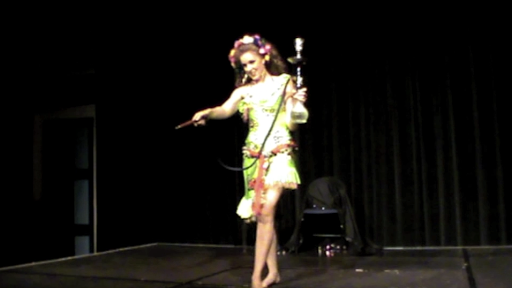
Galit Mersand performing shisha dance, bellydance, with melaya leff costume
Galit doing her shisha dance

Enter Galit Mersand. And Bellylicious, a one-hour cabaret show that combines stand-up, dance, and, once everyone’s warmed up nice and good, a bit of cultural background about the dance itself. Galit wrote the show to explain oriental dance to the general public, but to her credit, it doesn’t feel particularly teacherly. Well, until she dances raqs al assaya as a disciplining headmistress. Did I mention Galit is in the U.K.? Some parts of her show, you really need a public school education to understand.

This gives you a clue that the show, in the tradition of cabaret, doesn’t shy away from playing with the sexy, cheeky side of the dance. Galit starts out by describing herself as a “serial flirt,” and bellydance is, of course, the perfect artistic outlet for someone who likes to tease. Now, it just so happens that I come from a very, how shall I put it, flirtation-rich culture. It may be the case that I can go on for hours about how underflirty and misflirtatious North American society can be. (Don’t get me started on Germany…) I am so happy to have someone acknowledge that this is a big part of the dance. 

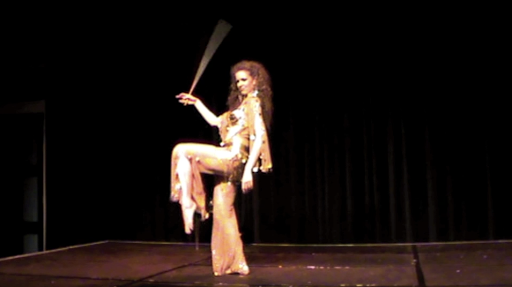
Watching a full show of bellydance might be a test of patience for the non-initiated. However, the dances themselves are not just plopped into the dialogue. In fact, they continue the themes of Galit’s jokes in a kind of bellydance-standup fusion. (It reminds me quite a bit of Cihangir Gümüstürkmen‘s work.) They are therefore all a bit experimental, and some work better than others. I could have done without the transformation of yoga positions into bellydance moves that starts the show off. But the “headmistress with stick” shtick was wonderful, and the drum solo that ends the show — mostly straight dancing, but with small comic bits that nevertheless fit the music perfectly — was a stroke of brilliance. And anyone who’s tired of “overacted” dancing, the kind with way too many gestures and literal interpretation of a song nobody present understands, will enjoy Galit’s sendup. 
 
Galit Mersand bellydancing with stick, cane
 
The thing that’s necessary for the comedy to work, the one element without which it would all flop, is dancing so good that even an audience member utterly new to oriental dance would be able to recognise as excellent. If a dancer made jokes about bellydancing and then performed with anything less than professional polish, the whole show would be an exercise in diminishing the art. 
 
And Galit’s dancing is excellent. Really, really excellent. She combines varied and precise technique with incredible lightness: everything looks easy and floaty and fun. I have seen so many technically brilliant dancers lately who make it look like hard work, and there’s something about that that’s exhausting to watch. But some dancers — Ranya Renee and Maria Sokolova come to mind — give you the sense that they’re having the time of their lives, and in doing so allow you to take pleasure in the music and movement too. And Galit is one of them.
 
It also makes you want to learn. While watching Bellylicious, one part of my brain was enjoying the dancing, and the other was thinking, “Oh, that’s a cool combination! Oh, that’s another one! I should look these up again. Oh, what a nice way of combining those moves!” Of course, Galit has instructional videos too (and I will be reviewing one of them), but I also expect I’ll turn back to Bellylicious for inspiration on movements, combinations, and general styling.
 
I received a review digital copy of Bellylicious from Galit — she sells her videos both on DVD and as downloads at galitmersand.com. (At the time of this writing, the latter are quite affordable, even once you convert from British Pound to whatever currency you’re playing with.) The video is spliced together from different shows she did, and sometimes the splices do show. Film quality is a little fuzzy, though you can see everything, especially when it comes to the dancing. And usefully, the credits include all the songs she used. 

Review of Elena Brower’s AM & PM Yoga for Beginners

When it comes to yoga DVDs, I go through phases. For a while, I was looking for something that would give me an experience similar to class, a long, intense practice that would leave me utterly mellowed out and exhausted. I was frustrated with all the 60-minute DVDs, wondering where I could find a “proper” 90-minute practice that would be like the real thing.

Now it’s harder. If I do yoga at all, it’s on stolen time. I steal some time from my work, because I know the yoga will refresh me and help me to concentrate better and with less caffeine. Or I steal some time from my sleep, because my back is already hurting and I want to wake up feeling better, not worse.

Elena Brower does pigeon pose

I recently dipped into my collection, and found just the right thing for the place where I am these days: Elena Brower’s AM & PM Yoga for Beginners. It’s incredibly straightforward: no sitting through long shots of foliage, no lengthy introductions. You get a menu, and you choose one of the workouts, or both. AM. Or PM.

The morning practice is about 36-minutes long. It’s slow-paced, geared more towards waking up your body and opening it into the positions than towards working up a sweat. You have a modified sun salutation, a lot of downward dog and back-soothing cat-cow combinations, a warrior series. Some twists and balances, and a little abdominal work. Elena offers modifications to increase the challenge in some of the poses. And it does the trick, leaving me rejuvenated, but not so tired I can’t work anymore.

The evening practice is 28-minutes long. I like the AM program, but I love the PM program. It has a lot of breathing, and deep, wonderful stretches. While many of the poses look quite basic, it’s the quality of the instruction that stands out. There will be a little variation, like a twist added to the pigeon pose (as in the image). Or she will guide you to do an asana with precise muscular awareness. I always thought that staff pose is easy, but now I see that doing it right takes a lot of attention. This is the kind of teaching that affects how I do other video yoga programs too. Last night, for example, I was working with a yoga app, and found myself remembering the instructions from Elena’s DVD.

What struck me most about AM & PM Yoga for Beginners was the way Elena works with breath, and this is where I think it gets interesting for dancers too. Instead of directing you to breathe into the stomach, she will have you breathe into the back, even curving the upper back in a little and straightening on the exhalation. All of the breathwork I have ever been taught in yoga, in class or on video, has been into the stomach, then chest. This is wonderfully relaxing, but it has meant that when I’m in dance class, and have to keep my abdominals engaged, I don’t know how to breathe anymore. I know that I’m supposed to breathe both into my chest and into my back, but my back muscles are tight and won’t budge. One of the reasons I’ll return to AM & PM Yoga for Beginners is this breathwork, which is also, in fact, practice in relaxing the muscles of the back to let more air into the lungs. It may just be the trick to breathing and dancing at the same time!

Review of Azhia’s The Dancer’s Companion: Preparation, Drills & Cool Down

I’m about to do something awful.

I’m about to review a DVD you can’t get.

Well, I’m sure you could try. Someone on Bhuz probably has it. But when I got the video Azhia was selling off her last batch. In fact, as far as I can tell, she’s retired as a dancer and focusing on her career as a makeup artist.

Which is a shame, because not only is she a beautiful dancer with great technique and a modern feel, but she has some cool ideas about how to put together a bellydance practice DVD.

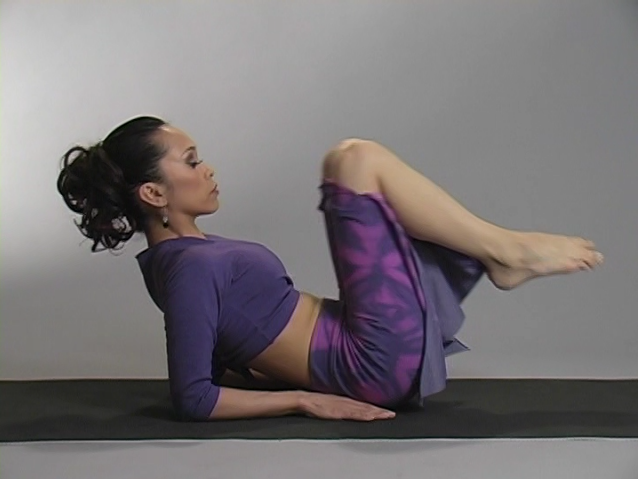
Azhia doing lower abdominal work as preparation for bellydance

The Dancer’s Companion: Preparation, Drills & Cool Down is a modular program composed of a brief introduction, a 16-minute “Preparation” for dance, 24 minutes of drills, a “Beyond Basics” section that suggests ways to vary the drills, and a brief cool down. Ah yes, and two studio performances.

The Preparation is not so much a warmup as a series of yoga-inspired stretches and targeted muscle work. It won’t get your heart up, but it includes some good things, like grand plies to work on thigh strength and exercises to strengthen the foot muscles. This section could be used on its own to prepare for doing another program — in fact, this was the main reason I bought this DVD.

The drills begin with arm positions layered on an ongoing shimmy. These are a little like some of the exercises I loved in Aziza’s arms DVD. Then we get hip eights, vertical and horizontal, performed in both directions and varied. Azhia has you do them both with heels on the ground and bent knees, and with heels up and straighter legs. There are undulations, up and down, and the three basic hip circles — large, small, and omi/afro. The neatest part of the drill section is right at the end, when Azhia has you work on a combo of all of the movements practiced, at different speeds, with different foot work, in order to get the transitions smooth. This is most definitely the kind of thing I need.

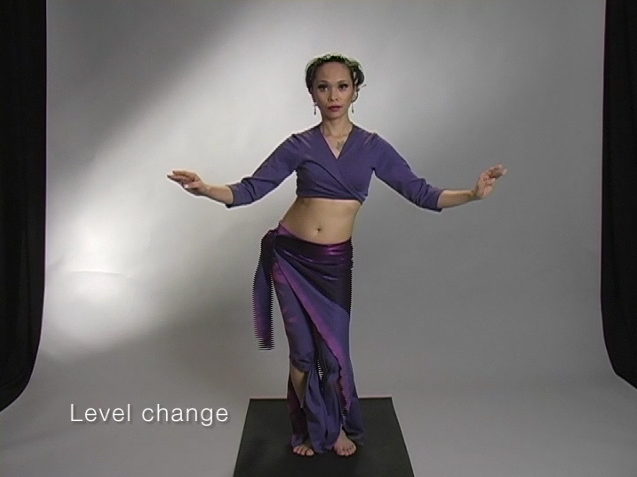
Azhia demonstrates how to change bellydance movements with level change

There are a few things that are difficult about following. Not every movement is cued, though most are, and she doesn’t mirror. So eventually I found it easier just to mirror what she was doing rather than listening to her say “left” and “right.”

That said, there are really some neat things about this video. It’s designed for you to grow into. For example, at various points she gives you tips on how to change up the movements. You might take a different arm position, or work at a different speed. The little “Beyond Basics” section is a mini-tutorial on more things you can do to get even more nuanced movements, like adding a twist to the lower body while doing vertical figure eights, or doing an omi with one heel up, or adding a level change. The result, as it looks on Azhia, is delicious, and it’s worth working towards.

Finally, the neatest thing is that the entire instructional part of the video is filmed in three angles: front, side, and back. You can either choose an angle at the beginning of a section, or flip between angles if you have magical DVD remote control powers. I do not, alas, have the latter, but I did find that watching the DVD on my Mac’s DVD Player, I could go to the Features menu and choose “Angle” to pick my angle, and it would switch right in the middle of the video. This seems like it would be particularly good if you’re interested in seeing how those horizontal figure eights look from the side, or if you want to follow Azhia from behind as if she were a live teacher.

Azhia demonstrates the side view of a bellydance horizontal figure eight

This is explicitly not a beginner video — you need to know your basics. But Azhia still gives you a lot of tools to check up on how you’re doing even when you don’t have a teacher in the room, as well as ways to grow beyond the basics of what she demonstrates in the video.

In which Nadira Jamal hits a home run

Nadira Jamal sent an email out to her list this week, and it was one of those things — well, quite frankly, it was one of those moments when it seems someone you’ve never met read your mind and decided to give you a good talking to. It’s called “Everything Else is Gravy: Why we need mere competence, not excellence,” and before you read further, you should just watch it here:

My confession: only a few days before this video came out, I had posted something a bit negative on facebook about my dance talent, or rather, my lack of dance talent. The truth is, I don’t even think I’m the worst. But I don’t have those years of ballet training, and there are certain things in dance — like staying on beat or learning choreos — that take so much work. Listen, I’m human. Sometimes when I look at the stretchy thin people who can already layer a shimmy onto a basic step in releve, I start to wonder what it is I’m doing.

The thing that was really new to me in Nadira’s talking to was this: she points out that sometimes, being too much of a perfectionist can keep you from learning and becoming better. The example she gives is thinking you need to be a top-notch performer before you perform, when really there are many performance skills you have to learn on the stage, by doing. I had to wonder how Nadira got in my head. I’ve taken classes for years, but only had my first real, proper, not just futzing around performance a few weeks ago. And you know what? As Nadira pointed out, it went okay for what it was. It was a student performance, I magically remembered the choreo, I had a big dumb grin on my face for most of it — I need to learn to appreciate that and feed off of it for the next time.

Years ago, I had a Tim Gunn bobblehead doll that stood on my desk and said “Make it Work” when I needed a little more motivation in my work. I think now I need a Nadira Jamal doll that says “It’s Gravy!” when I bring it along to dance class!

Review of Bettina May’s Bombshell Basics: Pinup Modeling Secrets Revealed

(Before you read this, why not sign up for my newsletter and never miss a post?)

When I received my review copy of Bombshell Basics: Pinup Modeling Secrets Revealed, with Bettina May, I didn’t quite know what to do with it. Who was the audience for this, I wondered? Who wants to dress up like it’s the 1950’s? What in the world is it for?

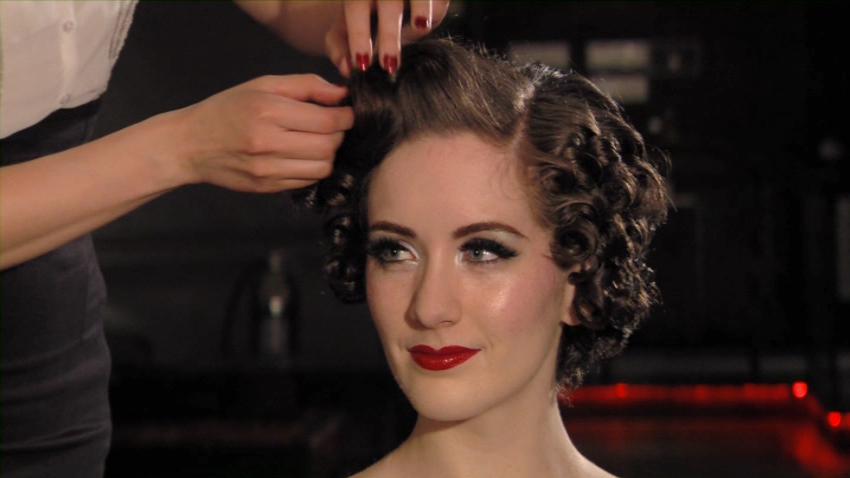
Burlesque dancer Medianoche with vintage hair
This is Medianoche, but you’ll be forgiven for thinking it’s Deeta

Looking back, some of the answers should have been obvious. Between the fame of Deeta von Teese, the popularity of burlesque and striptease workouts (of which World Dance New York has produced a bunch), the Mad Men craze, and hipsterdom’s tendencies to fetishize the past, there must be a lot of people looking for this kind of video.

You know what I forgot about though?

I forgot that I spent my teenage years adoring Rita Hayworth, that I basically wanted to be her, that I dyed my hair various subtle shades of red in wary attempts to get the look, that I played with my hair constantly to get those Golden Age movie star curls cascading down one side… at some point while watching the bright red-headed Bettina May do her thing on Bombshell Basics, this started coming back to me.

I also forgot that for a long time, a toned down 1950’s look was my makeup ideal.

How did I forget that stuff?

So, before I get into the nitty gritty, let me tell you what Bombshell Basics did for me. I didn’t dye my hair, and I didn’t set it in rollers. Nor did I purchase a vintage corset and lull about on a Victorian sofa, though if I wanted to, I would have known exactly how to do it. What I did do, however, was pay very close attention to the makeup instruction. And believe it or not, even though I’m no stranger to the ways of liquid eyeliner, the tips Bettina gave really solved some problems for me. I would even go so far as to say they revolutionized my eye-lining.

Then I went to my friendly local MAC store, meaning business. I got a Superslick Liquid Eye Liner, their Brick lip pencil, and after some very determined testing, selected my first Russian Red and the exquisite Viva Glam I. I have to tell you that I am not a MAC fangirl, and it had been years since I found anything to excite me in their store. (I’m way too old for Nikki Minaj’s face to part me from my money.) But I knew that for just the right red lipstick and deep black eyeliner, that’s where I’d have to go.

And then I started wearing it. And I’ve now switched from wearing pencil eyeliner most of the time to wearing liquid black almost as often. And I wear red lipstick. In the daytime. Just like that, because it feels good. And I adore it, adore how it makes me feel. I can’t find any way to write this without being cheesy, but you know what? I’m a grown woman with a job and a man and a child, I’ve earned my red lipstick.

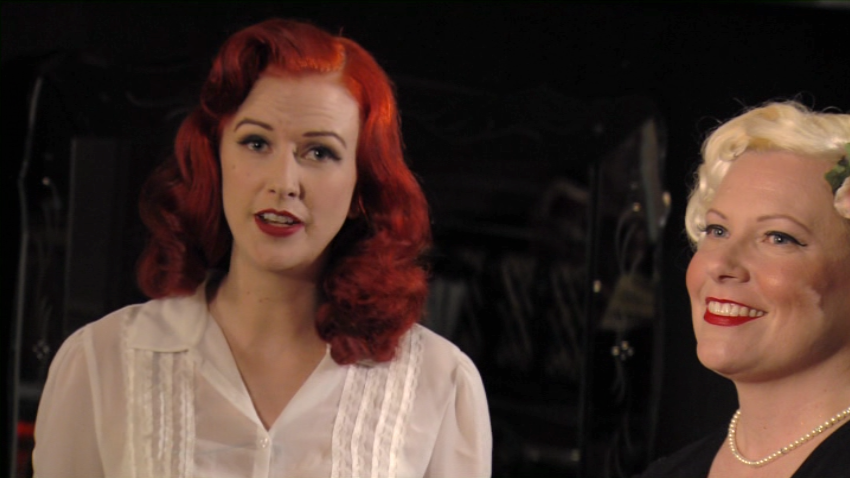
Burlesque dancer Bettina May showing vintage makeup instruction

What’s that? You would like to know what’s on the DVD? Well, ok.

Bombshell Basics begins with two sections on hair, one demonstrating how to set and style short hair, and another on very long hair. Bettina May offers a number of styling ideas, product suggestions, and little old school tricks. (“Grandma’s secrets.”) I was quite confused by this at first, since I didn’t understand why mid-length hair wasn’t being showed, and since we’re not shown how to set the entire head. Since I really don’t know how to put hair in rollers, I thought this would be useful information. I later figured out that a lot of this is covered in Bettina May’s earlier DVD, How to be a Pinup Model. I can understand the urge to avoid repetition, and a lot of the short/long hair ideas can be adapted to a variety of lengths. Still, I would have liked the full hair curling tutorial here.

The next section focuses on step-by-step pinup makeup. This is a guide to one look, a clean, rosy-cheeked, 50’s style look. The actual application is occasionally a bit rushed, but as I already mentioned, I found it contained some really great tips.

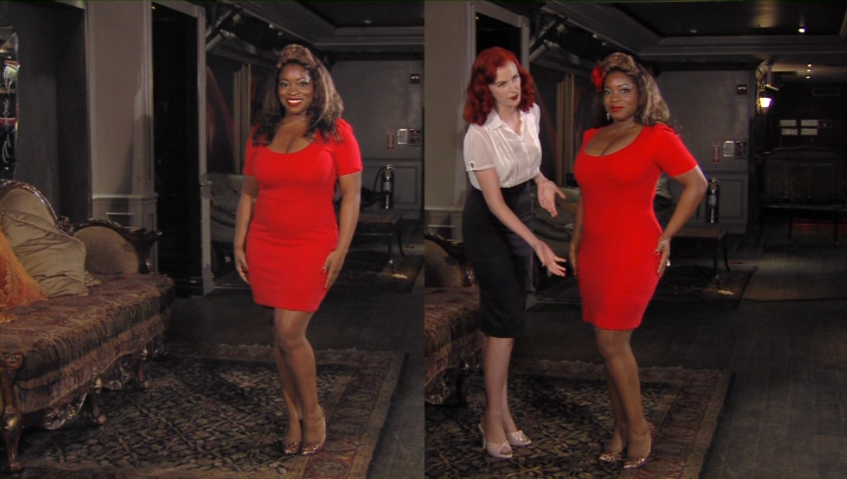
Burlesque dancers Bettina May and Sake Fevah showing modeling poses
Sake Fevah models underwear new and old

The final section begins a plaidoyer for vintage undergarments and what they can do for your figure. Sake Fevah models for us, and then demonstrates a number of poses that could be used if someone is taking your picture, or if a flirt-worthy individual happens to be in the room. Duly noted.

So who is this for? I think if you’re into the retro look, you’ll get a lot out of this, especially if you have long and thin hair, or short hair, and want to work the curls anyway. Bombshell Basics is not really a complete course in any one of the topics. Rather, it’s like a workshop, with ideas in every area — hair, clothing, makeup, posing. In this sense, I think it’s also rather nice as general style inspiration. You don’t have to look like a midcentury pinup, but you can still get a little of Joan Holloway’s charm in your everyday life.