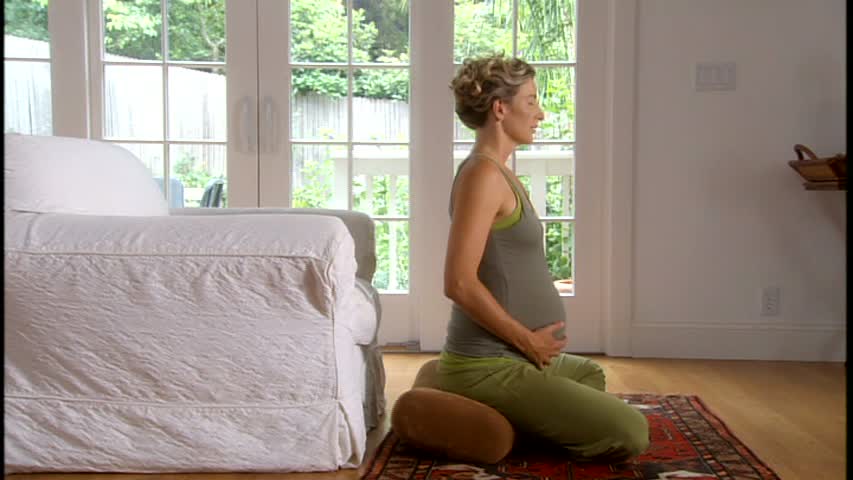
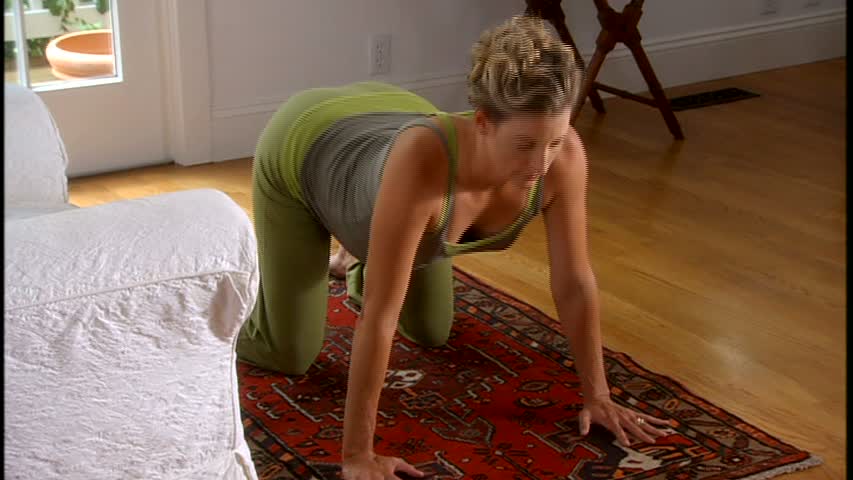
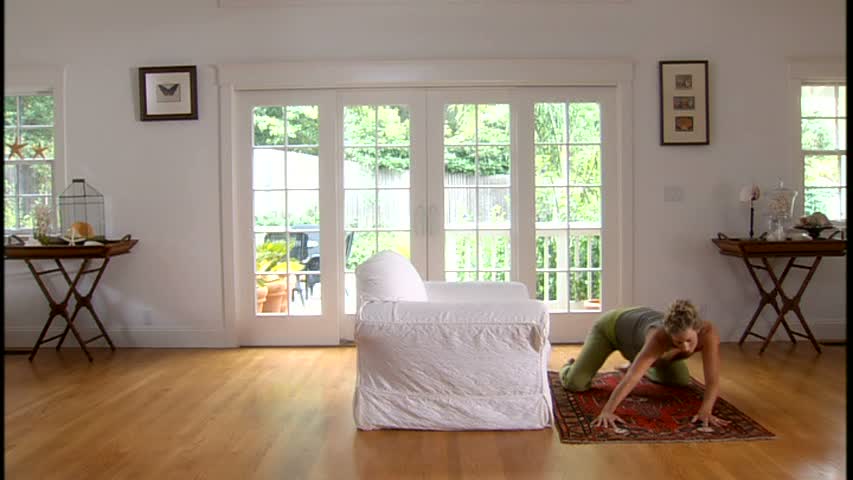
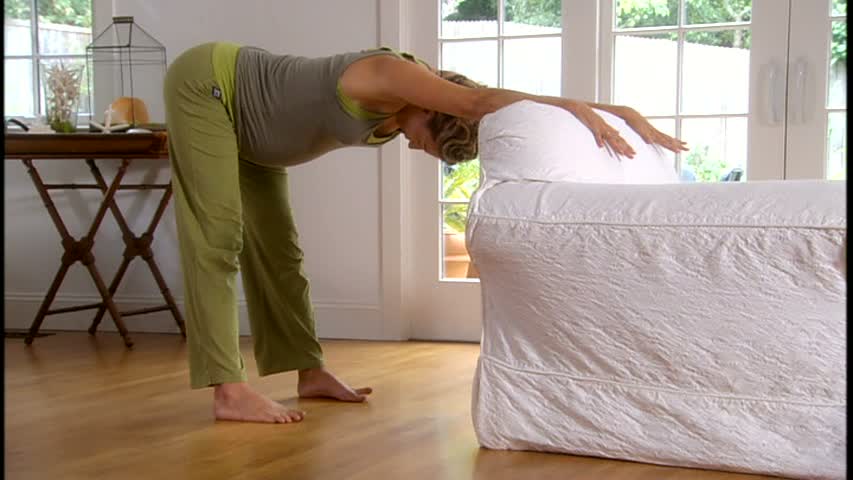
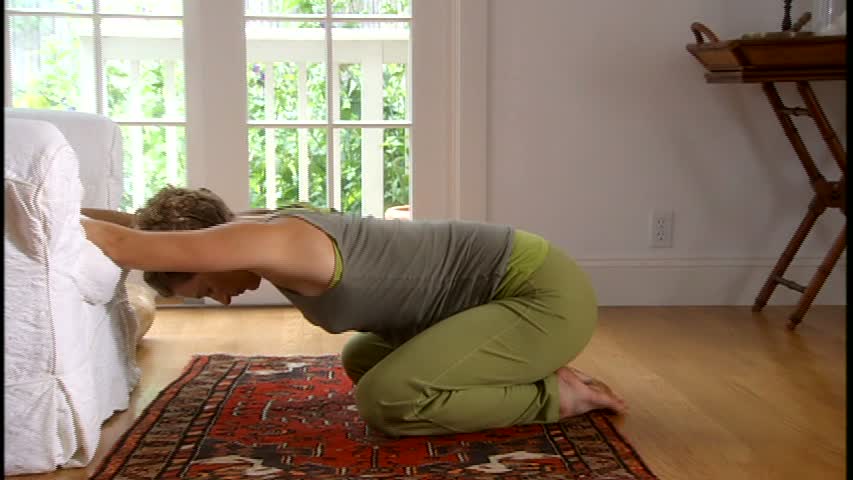
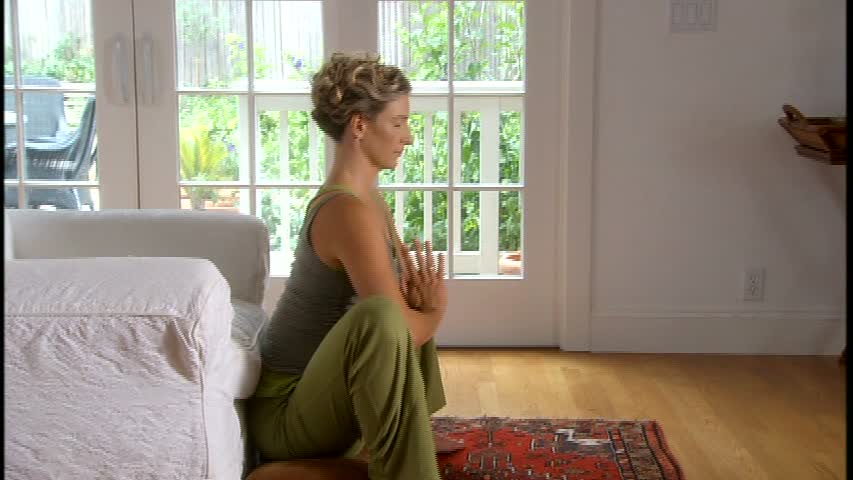
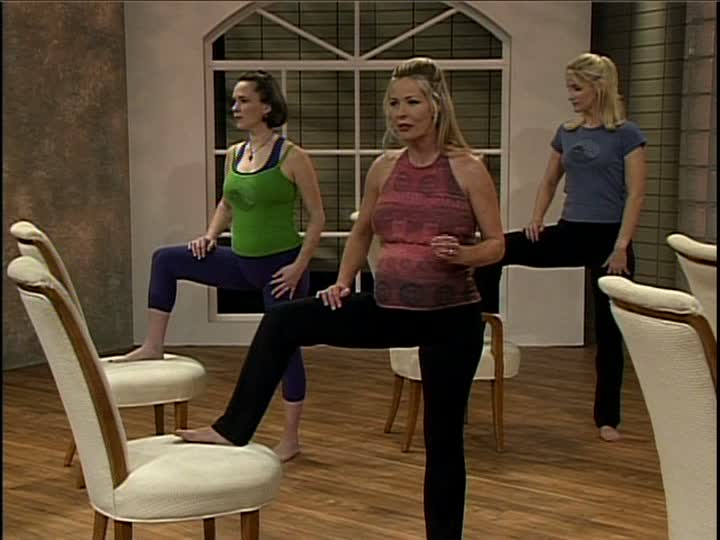
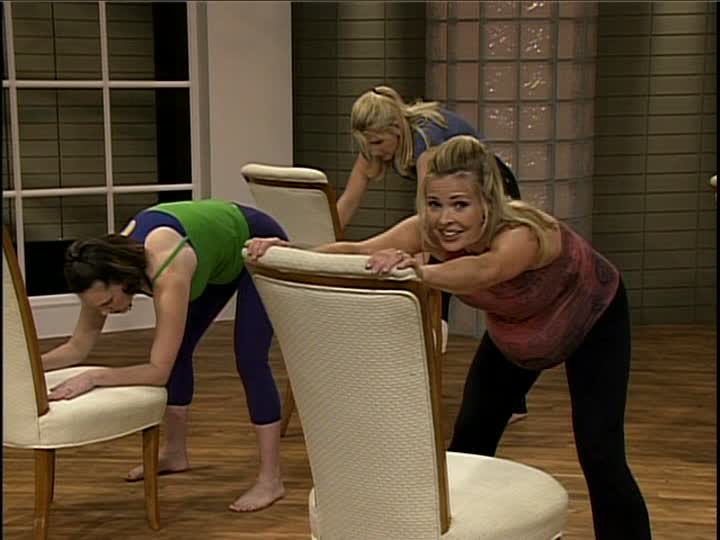
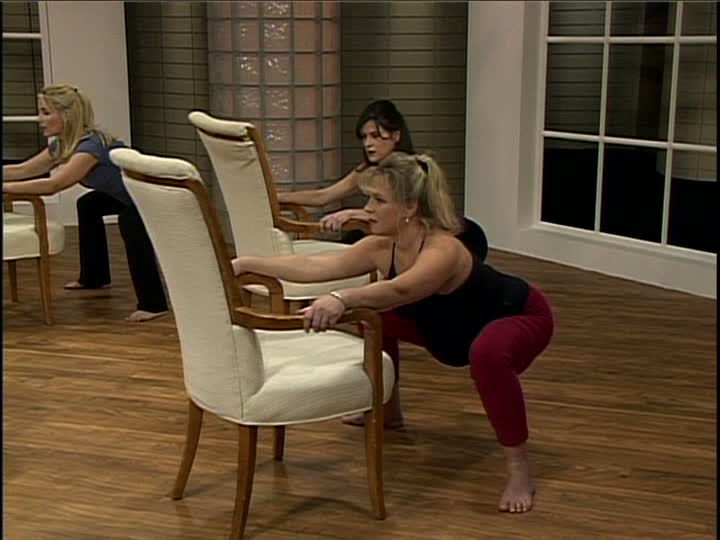
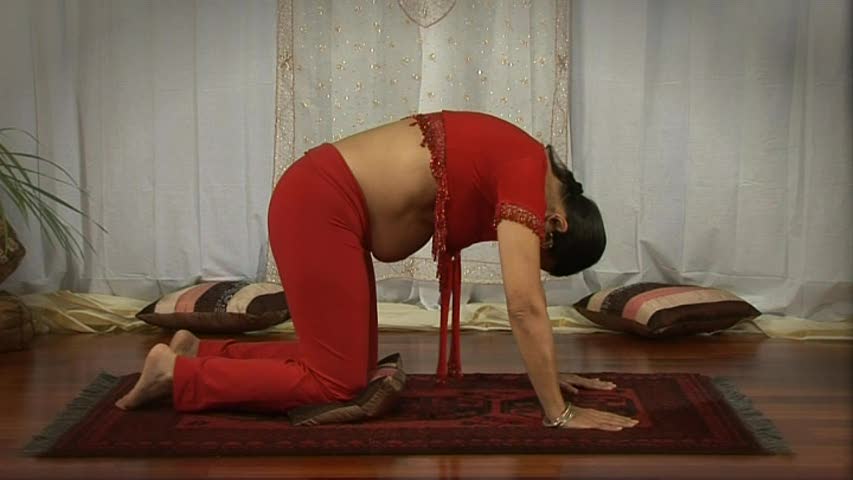
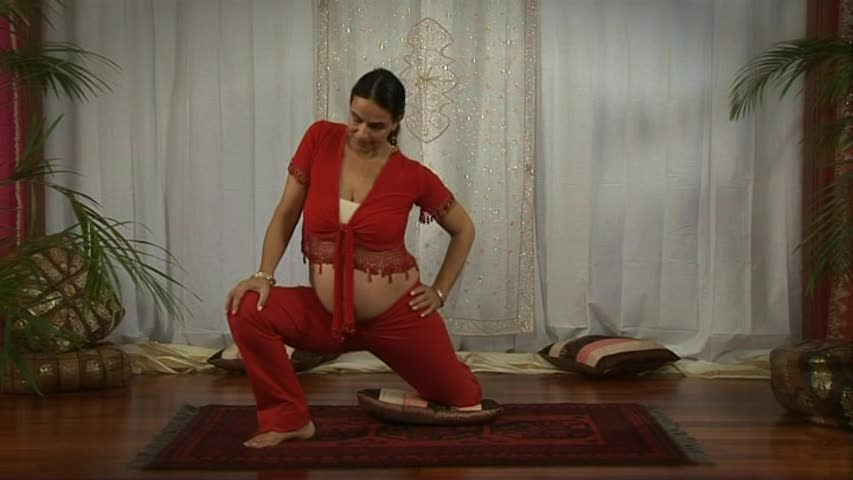
First workout with Helene Byrne’s Bounce Back Fast! Post Natal Core Conditioning

My mother’s day gift to myself? Starting to exercise again.

Even though there are many people who exercise before hitting the six-week mark, it’s my nature to have a sense of fearful respect towards any process that involves cutting my body open and rearranging my organs. So I was really careful to toe the line before I got my doctor’s ok: I didn’t lift heavy things, I didn’t exert myself too much — at least not two days in a row — and I did absolutely no exercise. Not even the lightest movements. None.

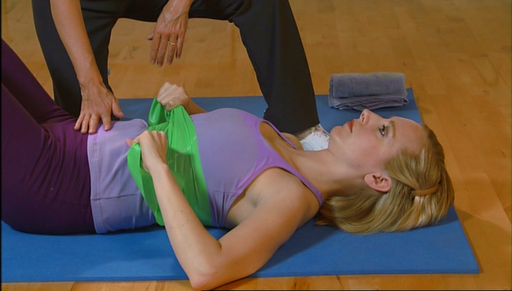
But man, was I ever dying to. So to ease into it again, I decided to start with my review copy of Helene Byrne’s Bounce Back Fast! Post Natal Core Conditioning. There are two workouts. “Gentle First Moves” can be done early in the postpartum period, and is all I’ve worked with so far. Then there is “Bounce Back Fast!”, with an “Abdominal Separation Program.”

Bounce Back Fast! begins with a series of informational segments on beginning postpartum exercise, using kegels to recondition the pelvic floor, dealing with Diastasis Recti (I didn’t have this so I skipped watching this segment), and ways to work the abdominals so as to pull in the stomach. I think it’s really worth watching through these at least once for two reasons. First, Helene introduces the postures she later calls on in the workout. And second, the tips on keeping the abs engaged during movement have made me much more aware of how I hold myself when walking, holding the baby, breastfeeding, and so on.

Now, let’s be frank here. This is not an exciting video. It’s filmed in a very plain studio, though the shots are very clear and professional. Helene enunciates everything slowly, explains in detail what the postpartum body needs, and doesn’t use cutesy words for body parts the way exercise video instructors sometimes do. There’s no “tushy” here. When Helene means “anus,” she says “anus.”

Nor is the workout exciting. If you were simply to watch it, you would probably think nothing is happening. And this, my dear readers, is why I always insist on doing the videos I review. Because this plain 30-minute workout, with no music and no flashing lights, is ridiculously effective.

I’ve done it three times so far, and each time I was suffering from upper and lower back pain before I began it. The first time I worked with the program, I felt pain relief the following day. The second and third times, I had no more back pain immediately after finishing the program. I am serious. One moment I was in lots of pain, and exactly half an hour later, I felt good.

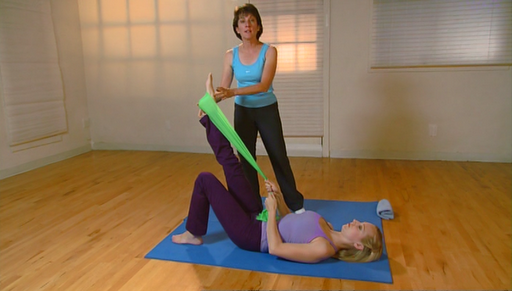
How did this happen? The exercises themselves are fundamentally basic stretches, the kind I know from physiotherapy and from pilates/yoga type workouts. They remind me quite a bit of the Viniyoga back therapy videos I love so much. However, Helene cues them with precise attention to which muscles should be tensed and which relaxed. And each of the exercises has something just a little bit different about them. One focused on pulling in the abdominal muscles uses breath work and hand spotting to get those loose muscles working again. (Incidentally, this particular exercise would be great for belly dancers looking to isolate lower from upper abs!) A hamstring stretch uses the included elastic band to do a gentle but powerful variation. These are just a few examples.

The other thing I want to note is that while these exercises seem like nothing from the outside, doing them correctly is very difficult, especially postpartum. While my strength and flexibility have improved with each repetition of the workout, I’ve also come to see more and more how much concentration they need to be done according to Helene’s instructions.

I’m looking forward to working with the second part of the workout. But I’m also looking forward to returning to dance and yoga instructionals, to say nothing of other postpartum exercise programs, with the increased awareness of my abdominal muscles taught in Bounce Back Fast!

Bounce Back Fast! is also available on www.befitmom.com.

Review of Bombshell: Dramatic Make up for the Stage, Photos & Glamourous Occasions

“If you look like the love child of a clown and a hooker, then maybe you have enough makeup on for the stage.”

Princess Farhana’s description of a dancer’s war paint sums it up pretty nicely. Bombshell: Dramatic Make up for the Stage, Photos & Glamourous Occasions is not about subtlety, appropriateness, or painstakingly blending taupe into beige. It’s about glamour, colour, glitter, and having a hell of a lot of fun with your face.

A bit of background about myself: I’ve never thought of myself as particularly girly, and I don’t wear much makeup on a regular basis. I like the look of fresh skin, so I almost never wear foundation, and I work in a slightly conservative field, so purple mascara is out for daytime. Well, I’ve described Dr. Jekyll to you, but there is also Ms Hyde. Lurking deep inside me is not a girly girl, but a full-blown drag queen just dying to come out.

As a preteen, Kevyn Aucoin’s Making Faces was my makeup bible: I studied the pictures and descriptions, and wondered where in the world one could get the cream eyeshadow he used so often. I would do outrageous looks with my friends and photograph them. I began to acquire a perversely large makeup collection, with probably every shade of glitter and eyeliner imaginable. In the year I was finishing my dissertation, as a full-fledged Serious Person, I would interrupt the tedium by painting high glamour makeup looks on myself, running and showing my boyfriend, and then taking them off. In grad school I even wrote a seminar paper on anti-cosmetic rhetoric, and did a bit of makeup of student theatre. And my secret plan B has always been to go to cosmetology school and run off to Milan.

So this is to say that I’m passionate about makeup, I know a lot of tricks, even if I haven’t tried them, but because I don’t wear huge amounts of the stuff on a daily basis, there are also quite a few things I don’t know. For example, although I own several sets of false eyelashes, I’ve never managed to put them on.

I’ve secretly always wanted to do a Cleopatra look

But I was, you can imagine, extremely eager to take a look at Bombshell. Princess Farhana kindly hooked me up with a review copy, and I’ve been watching it bit by bit over the past month. It’s a massive two-DVD set that covers some makeup basics such as tools, foundation and contouring, false eyelash application, and lips, and then proceeds to focus predominantly on eye looks: retro, movie star, smokey eyes, sixties’, Cleopatra-style, Arabic, modern colour-blocking, and mature makeup. (These are partly my names for the looks.) In a final chapter, Princess Farhana discusses the use of, what else, glitter!

What I was particularly curious about was this: when there are so many makeup how-to videos on YouTube (Lauren Luke famously used her YouTube channel to rise from rags to discount-makeup-riches), what would a DVD offer that would be new? Why shouldn’t I just watch a dozen YouTube videos instead?

Here are my answers to this:

– Video quality. Bombshell is professionally filmed, and it’s easy to see DeVilla and the Princess at work. This is not someone sitting in a darkened living room.

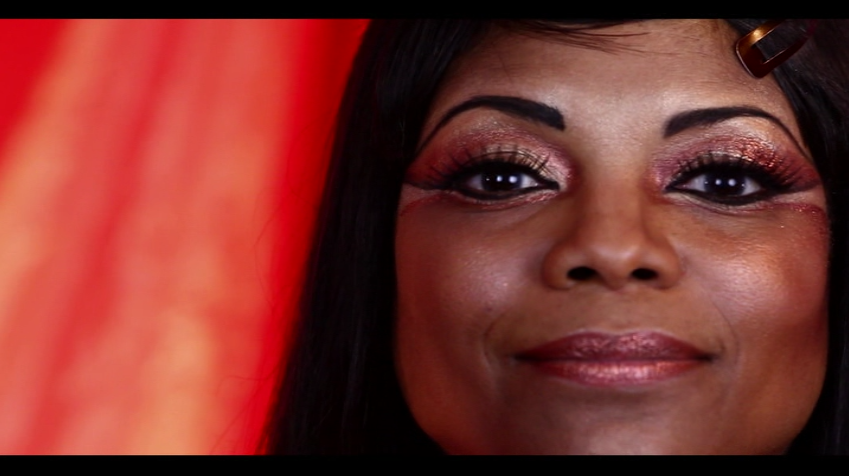
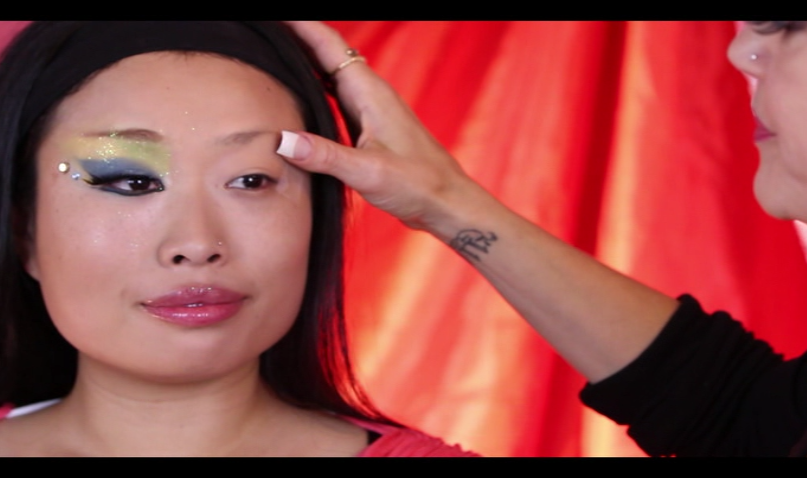
– Diversity. The models have different eye types, are of different races (there is an Asian and an African-American model), and ages. The Princess devotes one of the chapters to making hooded or small eyes look big. So while the instruction is nominally about how to do a variety of dramatic eye looks, all along there are tips and tricks for adapting makeup to different kinds of faces.

– Expertise. This is the big one! Princess Farhana, a bellydancer, and DeVilla, a bellydancer and makeup artist, bring their showbiz experience to bear on this. They teach a lot of techniques that are specific to the stage or to photography, skills such as: contouring for the stage, what colours look good in black and white photography, what looks bad in photography or in a small restaurant, how to use glitter to get glossy lips without the dangerous stickiness of gloss, how to use white makeup or crystal appliques to open up the eyes, and so on.

Throughout the videos, they differentiate between stage and everyday makeup looks, often suggesting how one look might be toned down or played up for a different context. They also give specific advice for performing in a restaurant or on a small stage vs the big theatre. This is the kind of expertise you won’t get on YouTube! I even liked the fact that, in the section on lashes, DeVilla demonstrates a painstakingly precise way of applying them, and Princess Farhana shows a quick and dirty showgirl version.

While I’m unlikely to be on a large stage anytime soon, I did learn a few things I can take away. For example, I’d used dots of white goo in the corners of eyes when doing stage makeup, but I didn’t know the more subtle ways this could be adapted to everyday wear. Princess Farhana shows some faster ways to blend, using her finger or glitter, that I might try when in a rush. And I’m much more likely to experiment with colours or combinations I don’t usually use. Such as lavender. Who uses lavender?

Is it still an objective review if I want to hang out with these two?

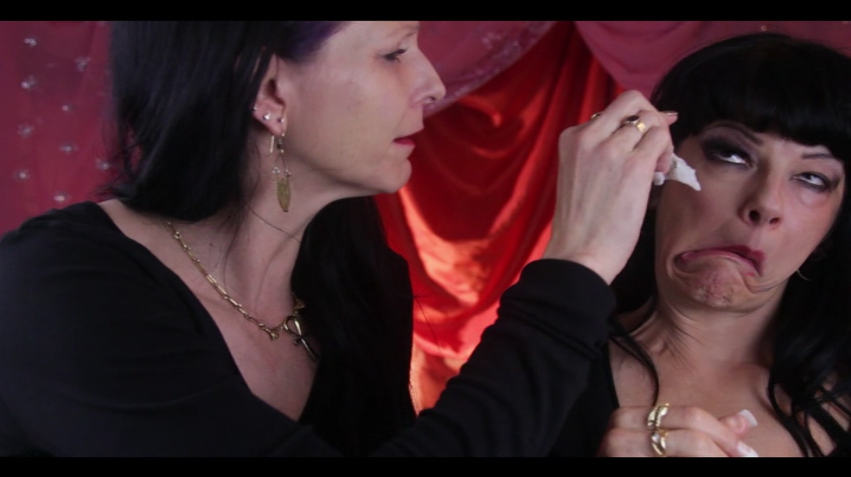
My favourite aspect of Bombshell is the way its two stars come across as completely chill and playful. I took a workshop with Princess Farhana ages ago, and I love her wacky sense of humour. She’ll be working on a look which looks completely ridiculous, but she’ll acknowledge that that particular step in the process looks weird, or that she’s making a stupid face to put on eyeliner. Then again, her little quips — she describes one makeup look as hanging out in an opium den with Rudolph Valentino — also show her range of references. (I have to think of those moments on RuPaul’s Drag Race or Project Runway when contestants don’t know what the 1940’s or 1970’s looked like! I always sound a deep, melancholic sigh.) In a final scene, DeVilla and the Princess wipe each other’s war paint off, laughing away. It’s just the right spirit: makeup is fun, a way to be outrageous, and always forgiving. After all, in what other part of life can you always wipe away your mistakes and try again?

Putting mom’s body together again

Yesterday I swam for the first time since last October. Having finally received the go-ahead for exercise at my six-week check-up on Monday, I spent what free time I could carve out during the week doing a series of activities I hadn’t been able to for ages:

1. Tuesday: I took a hot bath.
2. Wednesday: I got a massage.
3. Thursday: I went swimming.

I’ve come to see these as necessary activities not just for me, but also for everyone around me. On the especially exhausted days recently, not only have I been miserable, but I’ve managed to make everyone around me miserable too. The destructive power of an unhappy mom is considerable! So my husband knows to send me out of the house when things are getting bad. On one particularly exhausted day, he said to me, “Why don’t I watch the baby and you go to Half Price Books and buy some books?” Now, I need more books like I need a tornado to go through my living room (oh, wait…), but I dutifully went and did what I needed to do for the sake of my soul. I don’t think what he did is pictured in Porn for New Moms, but it should be.

Anyway, to return back to swimming… During my pregnancy, I splurged on prenatal massages twice. I don’t usually go for massages, but I thought my body deserved them then. But what surprised me was how psychologically important they were too. Even during a pretty easy pregnancy, I still felt like my body wasn’t really my own anymore. People stared at my belly, and every time I went to the doctor’s I was poked and prodded in various ways. It started to feel like my abdominal area was just a totally different part of me, available for the viewing and inspection of others. When I got a prenatal massage, I nearly wanted to cry, since it was the first time I felt like a whole person, with body and mind both belonging to me.

Fast forward to labour, a c-section, breastfeeding… now my body feels even more cut up into chunks. This bit is for the baby, this bit was cut up and needs to be kept dry and not used for anything, this bit is still bleeding, this bit hurts from lifting the baby, and this other bit hurts from bending over too much. It’s a completely fragmented experience of my own body. And while massage and the bath helped a bit, it was really when I went swimming that my body didn’t feel like bits anymore.

Plunging into the water I felt shocked by its coolness, and so I focused on that. I had been a bit scared about my first bit of exercise — would my abdominal muscles hurt? Would I feel them pulling the way I did a few weeks ago when I stood up holding the baby? But they felt fine when I started swimming, my back pain went away, and suddenly I could just give in to the meditative flow of being in the water. I’ve never been a particularly strong or skilled swimmer — in fact, I really only started to like it in university, after reading a book on swimming and working on my technique (yes, I do everything via book learnin’!) — but I can now breast stroke for ages.

Even more surprising than the fact that my body felt ok, in fact just like my old, pre-baby body, was this: I found I wasn’t getting tired at all. You would think after six weeks of no exercise, lack of sleep, round-the-clock breastfeeding, and only short walks, the first bit of cardio would have me huffing and puffing at the edge of the pool. Not only did that not happen, but I only left the pool because of the cold weather, not because I was tired. I really felt I could have gone on swimming for another hour, forgetting all those worries and to-do lists that usually fill my head.

I am now really looking forward to starting some gentle postnatal workouts and bellydance…

My son, future dancer

One of my goals as a parent is not to impose my own desires on my child. I’ve seen it happen too often that parents try to live out their unfulfilled dreams through their children, usually to the frustration of those children. The trick is: what’s the line between trying to revive a lost cause through your kid and just sharing your passions and hobbies with them?

I’m starting to realise the extent to which this is true since, spending a lot of time with my baby, I keep imagining possible futures for him. And unlike those moms who imagine their kids becoming doctors or athletes or lawyers or other important muckymucks, I’ve become convinced that my son has the right build to be a dancer. He has these beautiful, slender legs that I’m convinced will be long, he’s strong and seems to want to stand on his own despite his six weeks (tomorrow), and when feeding, sleeping, or just hanging out, his hands will fall into the most graceful shapes. For an example, see picture.

It’s not that I want or expect him to become a professional dancer, but I like the idea that he will enjoy dancing. The truth is though, even this quite basic and understandable desire is about me. You see, music and his reaction to it gave me one of the most important moments of joy, of connection as a mother, in the last few weeks.

Back track a few months. Baby — just a fetus at the time — was starting to respond to sounds and music outside the womb. My husband and I were watching Fatih Akin’s documentary of Istanbul music, Crossing the Bridge: The Sound of Istanbul. I was lying on the couch, and my husband had his hand on my belly, feeling the occasional shifts and movements. Late in the movie, there’s a scene on the outskirts of Istanbul, in a bar filled with Romani musicians. The musicians are well sauced, and the music is frenetic. One of the Roma interviewed talks about the spirit of the music, how in hearing it, you simply have to get up to dance. When classical Turkish music is played, he says, people just sit and watch.

All the time, the song is rising in a crescendo, the baby is moving like mad, and when the final beat strikes, he gives a good, solid kick in perfect time! My husband and I both feel it and look at each other in amazement. This only grows in the next scene, a short of classical Turkish music — true to form, the baby stopped moving immediately and stayed still for the rest of the movie.

We joked many times later that he liked gypsy music. In fact, as a fetus, he tended to react to fast dance music in general. Fast forward to five weeks after birth. I am tired from interrupted nights and what feels like constant feedings. I am gradually growing in love with this beautiful little creature, but I don’t quite know what to do with him yet. Newborns aren’t very interactive, after all. And then, one day when I’m feeling down, I remember the music he liked in the womb.

So I get the iPod that usually plays rain sounds all night, search for some “gypsy” music, and play it for him while he lies on the bed. We listened to Romanian and to Flamenco music, and his little arms and legs flew in every direction. Sometimes I guided his movements, sometimes I let him just react to it on his own. And can I add that random baby flails sometimes look like flamenco arms? Just sayin’.

Maybe he was reacting to the music, grooving in his own baby way. Maybe he had no clue what was going on. I never can tell with him. But it was a real moment of connection for me, reminding me that the little boy who now runs my life was once in my womb, dancing in time to the beats outside.

Reader, I birthed him

If you’ve been reading this blog, you know that my interest in prenatal workout videos wasn’t purely theoretical. Workout and dance videos were a way for me to keep moving — albeit gently — throughout my pregnancy. In fact, they made it a beautiful one, since I had never before paid so much attention to my body’s needs. I never pushed myself incredibly hard, since I wasn’t looking to lose weight or set any records, but I did use exercise to deal with back pain and to work on my flexibility and endurance. They say, after all, that labour is like a marathon, so I thought I would train as best I could!

Marathon, eh? Well, if the average marathon time is 4:35 hours, I could have run over seventeen marathons in the time I laboured. Because, dear reader, while my pregnancy was a dream, labouring to bring my son into the world was all kinds of funky. When I write “funky” I don’t mean “life-threatening” — both he and I were pretty resilient throughout the four days I was in labour, and I’m well aware of how important that is. But all kinds of little things made my hope of giving birth in the traditional way difficult and, eventually, impossible.

Now, beware — this is one of those revealing, personal blog posts full of Too Much Information. It’s the kind of stuff I don’t always feel comfortable talking about, much the writing about it online. But it’s my blog, after all, and a few people have asked me how things went. If you don’t want to read this — just click somewhere else.

I started to labour on a Friday morning, in the car on my way home from an appointment with my ob/gyn. By Friday evening my contractions, which were not yet very strong, were 2-3 minutes apart and lasted anywhere from 60 to 90 seconds. Our wonderful doula came over, and she judged it was time to go to the hospital. Once there, my contractions almost immediately stopped. I was kept under supervision for several hours, and since nothing was happening, they gave me an Ambien and sent me home. And that, my friends, was the last full night of sleep I had.

On Saturday, I continued labouring at home. This was the lovely part of the labour, despite the pain getting worse. I had Middle Eastern music playing on my iPod speaker, I did hip circles and chest circles and what have you, and my husband applied warm packs and gave me massages as things got progressively harder. Inspired by the outdoor bits of Maha al Musa’s Dance of the Womb, we went outside to the park behind our apartment and walked over the hills, using the inclines to get through contractions. Because of the way the baby was positioned, some basic movements like cat-cow stretch were extremely painful, but there was so much else I could do, and I still felt quite positive and hopeful about the experience.

Saturday night we did not sleep.

Sunday morning, thinking my waters had broken, we went to the hospital and called our doula again. They hadn’t broken, but this time they kept me in. Now, I had worried about the hospital’s openness to natural childbirth. Everyone I knew who had given birth there had had a c-section, a prospect I found terrifying. And, in fact, the hospital staff were so unaccustomed to any woman actually being mobile enough to walk through the halls, as I was, that some of them didn’t think I was in labour yet. Everyone else there was hooked up to an epidural as soon as they got in! However, to my surprise, both nurses and doctors were incredibly supportive. They took our birth plan seriously, I was allowed broth and water (against the usual hospital policy), no one rushed me or came to bother me, and aside from the bare minimum of precautions and checks, things were allowed to progress naturally.

Moreover, I had brought my iPod player with me, so to the surprise of the nurses, we had Middle Eastern music playing in our room and I often danced through contractions, at least during the early part of the day. I found to my surprise that the most useful moves for me were undulations, which helped with the back pain, and that I would often naturally do a shimmy just as a contraction was wearing off, as a way of relaxing my body out of it.

Which was, it turns out, incredibly slowly.

At this point I also had back labour, and certain things — like going to the bathroom or being on all fours — were excruciating. I had progressed so little, and the baby seemed to be malpositioned, so we tried all the natural methods to turn him. We figured there was a chance, since my waters still hadn’t broken. I spent almost an hour on all fours moving from side to side in a haze of pain (I actually don’t recall most of it), my doula tried shifting my hips with a scarf, the whole enchilada. This did nothing. For much of Sunday evening I thought I was going through transition, as I was showing the typical signs according to my doula. I was, it turns out, not going through transition.

Sunday night we did not sleep.

At some point during the night, I did get some painkiller though, through the IV, so at least I had two hours’ break from the pain. On Monday morning I agreed to have my waters broken, at least to move things along. What followed was pain so horrible that I thought I would die pregnant and in that hospital room. All the breathing and relaxation exercises I had done until then were quickly losing their effect. Aside from having contractions that were 2-3 minutes long, with back labour, the contractions were also not the usual kind — they would generally start at the peak of pain and either wind down, or not. They were, in short, unmanageable. And the worst part was that this pain had brought us almost no closer to the end.

My doctor walked in, found me screaming on the bed with my husband on one side and the doula on the other, and said, “This woman needs an epidural and a few hours of sleep!” Seriously, I would have asked for an epidural myself if I could have remembered at this point that they exist. The pain and fatigue were so overwhelming that I truly didn’t know there were options for me. I was focused on survival. But when my doctor said those magic words, I yelled, “Yes!” and the magic happened.

Now, I have nothing against epidurals. I don’t think women should have to suffer. But I had wanted to avoid the epidural because it so often leads to stalled labours and c-sections. In my case, the epidural helped me get a few hours of sleep and relax to 10 centimetres. The doctor gave me a few extra hours to bear down, and I was ready to push. All was going well again, and the finish line was in sight. Or so it seemed. My nurse came and taught me how to push, and I started doing so, with various nurses and my doula giving me advice. At this point the epidural was wearing off on one side, so I could partially feel my contractions (and back labour, my old friend), and was basically mobile. I pushed and pushed and pushed. I pushed on my back. I pushed on my side. I asked to push on all fours, which the nurses didn’t want to allow because they thought I couldn’t move my legs. But my epidural was weak enough that I was still mobile, so I pushed on all fours. Again, I lost track of time. I remember the period as very short, but my husband tells me I pushed for two hours.

And then my doctor came in, gave me the kind of examination that belongs on a specialty video of dubious respectability, and informed me that the baby had not progressed one bit.

This was, after four days of labour, and moreover, after four days of constantly thinking we were almost there, that the baby was going to come, extremely dispiriting. I asked what the options were, and she said she could have me push some more, use forceps to try and turn him, and then have me push, but that it might not work. In that moment I knew it wouldn’t. I barely had any more strength. I hadn’t slept in three days, hadn’t eaten in two, the epidural was no longer masking the pain — and I could no longer handle the pain. And although I know forceps can be fine and so on, I just didn’t want to subject my baby to the risk. He had been so strong over four days of labour, and I just didn’t think it fair to put him in danger because of my desire for a vaginal birth. I looked at my husband, said something like, “I don’t want to do this, I want the c-section,” and we agreed on the decision in a moment.

The sight I remember, the sight that stays with me, is seeing my husband and doula crying at this point. I thought they were crying because they were upset, but he later told me they were both relieved for it all to be over.

Once I made the decision, I became calmer, although I was still terrified of the surgery. I started chatting to everyone, fiercely trying to keep my mind off of it. My nurse later told me that on the way to the operating room I commented loudly that I was afraid my husband would never look at me sexually again. In the room, I remarked that it looked like a public bathroom, and then asked my anesthesiologist if he played the guitar and if not, why not. And after they got the curtain up between me and my about-to-be-sliced-open belly, one of the doctors on the other side sweetly asked, “What are you going to say to your baby when you see him?”

“FUCK YOU!” I replied.

A clip of time later, they held a monstrous-looking, squawling, bloody baby above the curtain and then whisked him away to suck a bit of meconium out of his lungs. I somehow remember him being purple and green at the same time, though I know this can’t be true. I was already shivering uncontrollably, and now I started weeping uncontrollably. When they brought him to me, I started crying even harder, and I said what I’d said I would say — but lovingly, softly, and in my native language. He was 8 lbs 7 oz, and he was finally out, thank goodness.

So that, dear readers, is my birth story. To be honest, it was quite traumatic. And yet everything was the opposite of what I expected. I was worried about the medical establishment, and in point of fact they made me feel totally empowered and respected my wishes. I tried so hard to avoid the epidural and the c-section, but by the end of the marathon, both of them were massive sources of relief. I was traumatized and detached from the baby for quite a while, but it wasn’t because of the medical aspects of my birth — it was because for me and my body and the position of my baby, natural childbirth just sucked big time. (My mom had a similar experience, so I guess it may be partly genetic.) The two good things were that I had a healthy, sturdy boy, and that I don’t feel guilty about the operation — I really know I did everything in my power to give birth vaginally. Any more would have been, in my case, stupid.

So to return to the topic of this blog… did all that exercise, the yoga and the pilates and the dancing help? For a while I thought they didn’t, that they were a bit of a big joke. They certainly helped me a great deal to enjoy my pregnancy, but I felt that they didn’t bring much to my labour. (All of those exercises you’re supposed to do to put your baby in the right position? I had been doing them for months. Much good it did me.) If I had given birth on Sunday evening I still would have had a long, three-day labour, but it would have been a dream birth experience in many ways — time spent at home, music, free movement, no meds, deep breathing, and a rather satisfying series of foot rubs from my husband. But the intensity, fatigue, and frustration of Monday were what made the experience hellish.

And yet, as time has passed in the intervening month, I’ve realised the exercise did help. On the one hand, the videos made me feel I could have a natural, vaginal birth, and for me the fact that I couldn’t wound up being sad and almost a bit angry-making. Why couldn’t I, after practicing all those squats? Still, most of my labour was manageable and under my control, and movement — especially bellydance — was a big part of that. Moreover, someone pointed out to me that I had the bodily strength to get through four days of labour, three of them without any pain killers. Since I’m not usually the fittest person, this had to have been due to all the workout videos I did. The fact is, try as we might to do everything right, some of us will not have the dream birth experience. But even though my birth didn’t go the way I pictured it, most of it did, and those parts really are beautiful.

And, in the end, what can I say? The kid is damned cute.
Moves and positions for an active labour

A few of the DVDs I’ve worked with have small bonus sections describing how to adapt the main program to labour itself. Since I’m unlikely to be able to find just the right section in each while in labour, I decided to make a little picture review of the available options. The videos themselves have detailed instructions I will not reproduce here, but I offer this post as an inspiration and guide.

From Yoga for Your Pregnancy:

Seated pelvic circles in both directions:

Cat-cow pose:

Wide hip circles while on all fours, with knees far apart:

Supported downward facing dog:

Same thing, but on knees, really relaxing upper body:

Supported squat:

From FitMama Prenatal Workout:

Rocking motion to help baby work his way down:

Cat stretch, in different positions, for contractions:

Deep squat, rounding back during contraction:

And, of course, there are all the bellydance moves: circles, hip sways, undulations, figure eights…

What moves helped you during your labour?

Review of Maha Al Musa’s Dance of the Womb

As I near my due date, my thoughts turn more and more towards preparing for birth and labour, rather than just keeping fit and dealing with the aches and pains of pregnancy. For a while now I’ve been watching and working with sections of the Maha Al Musa’s 2-DVD set, Dance of the Womb: A Gentle Guide to Belly Dance for Pregnancy and Birth (which I received as a review copy), and I’m happy that I’ve played with all of it just at the right time in my pregnancy.

In what sense? Dance of the Womb is much less a workout, and much more a guide to and meditation on connecting with your body to have the best pregnancy and birthing experience possible. To be frank, I don’t think I would have appreciated it very much in my second trimester — I did take some peeks into the program, but was not moved to work with it just yet. And I was lucky to have a pretty active third trimester, for the most part, which enabled me to take on more challenging prenatal programs and even normal dance DVDs. (Though I wasn’t jogging or weight lifting or anything I probably wouldn’t do anyway!) But working with Dance of the Womb as everything in my body is starting to get heavy and painful, and as labour itself approaches, has been just right.

Dance of the Womb has two very different components. One DVD contains a short film of Maha’s home birth of her third child. Between beautifully-shot landscape scenes, photographs, and videos of the birth itself are interspersed interviews with Maha’s midwives. This is an intensely personal film, and really, for lack of a better word, quite amazing. Again, I think this isn’t something I appreciated so much earlier on in my pregnancy, but as I’ve come to see how many of the women I know wound up with cesarean sections recently (the vast majority), I’ve wound up more passionate about being able to labour naturally and with a minimum of interference. I would be too nervous to have a home birth, at least right now, but seeing that it’s possible, and seeing Maha do it, is truly inspiring at this point in my pregnancy.

It’s also inspiring in a practical way. Labour is a long process in many cases, and very different from what they show in the movies. Actually, it’s also quite different from the movies I saw in the Lamaze class on dealing with pain naturally and in the hospital’s prepared childbirth class. Those tend to be shorter and to focus on the last, most painful part of the first phase of labour (transition) and the birth itself. As astounding as all of those births are (both my husband and I are in tears when the lights go up), the videos themselves make the process look rather horrifying and unmanageable. The documentary in Dance of the Womb has a lot of shots of Maha walking and moving around, and as boring as this probably is to someone not currently with child, it’s great to see how she manages most of labour, and that she can manage it. The video also inspired me in nitty gritty ways. While I don’t live in the paradise of nature Maha inhabits, I do have a little bit of a park just outside my apartment, and only when I watched her video did it occur to me that I could spend some of my time outside instead of cooped up, communing with the carefully landscaped nature available to me!

Astoundingly beautiful

The first DVD contains the dance program itself. This is broken down into the following chapters:

Warm Ups (45 min)
The Circle (26 min)
The Spiral (9 min)
The Figure 8 (12 min)
The Cervix (4 min)
The Hands & Arms (13 min)
The Chest (7 min)

This is, as should be obvious, an enormous amount of instruction and practice time. What this means, practically, is that it was a little tricky for me to get started with it. I really had consciously to set aside a good chunk of time for it, and even then had to break it apart into two sessions. Again, this makes sense at the end of pregnancy, as I wind down from the usual pace of my work and more carefully take time to take care of myself.

 
The Warm Up is a program all on its own, comprised of a variety of yoga-based stretches and movements for improving bodily mobility. The instruction is incredibly precise, and the pace is slow. There is much focus on concentration and breath. Despite the fact that I’ve done what feels like a million prenatal workouts by now, I was still surprised by how many movements in this section were new to me. They effectively stretch every part of the body (every part), and are quite satisfying. I’ll add that I was working with this during a pretty high anxiety week, and it really helped to calm me down.

The subsequent chapters are all dance based, but also all subtly different from each other. Each takes as its focus either a part of the body or a basic shape associated with bellydance, and each teaches bellydance movements. However, some chapters are structured like more typical dance instruction, and teach you movements and variations on them (like the figure 8), while others introduce a basic shape or idea and then have you move and improv freely (hands & arms). Instruction is detailed and from the ground up — while I picked up some new things, a woman who had never bellydanced before in her life could learn to do these movements comfortably and safely. Moreover, Maha often gives tips on using the particular movement in childbirth, especially when the form would be different for labour than it would be in “proper” bellydance.

The key sections are the circle and the spiral, probably because those are the most elemental movements both for bellydance and for birthing. The focus here is really not on dancing in a performance sense, but on using the movements to enter a meditative, trance-like state. And it works, at least for me. Again, this is a quality of the video that I think makes it less suitable for an energetic early pregnancy, but fabulous for the end stretch. If I go into labour tomorrow (and this is not unlikely), I will probably play the circle and spiral chapters and move along with them.

You have to be creative to figure out how to suit the program to your needs. The 45-minute warmup would be enough for any day, and does incorporate some of the bellydance moves too. You could do the warmup and then a variety of chapters, or just some of the chapters on their own. The pace is slow and careful enough that I don’t think a lengthy warmup is really necessary.

Dance of the Womb: A Gentle Guide to Belly Dance for Pregnancy and Birth is a valuable compendium of preparation, information, and inspiration for birth.

Doumbek follies continue: it’s time to take off the wedding ring

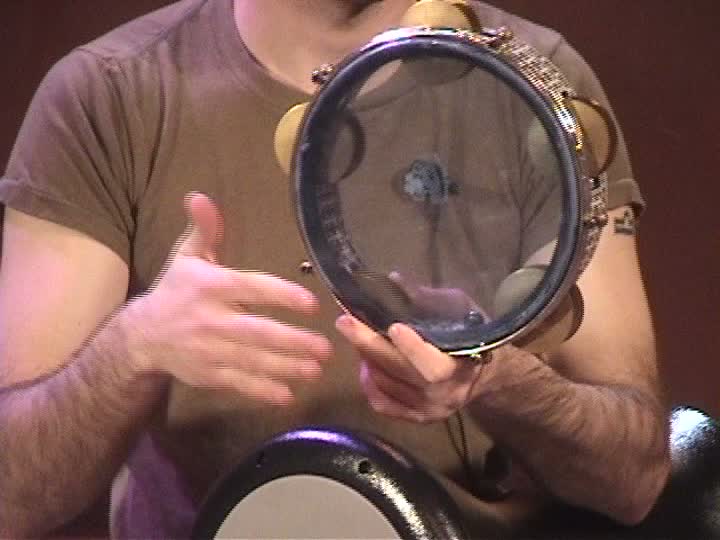
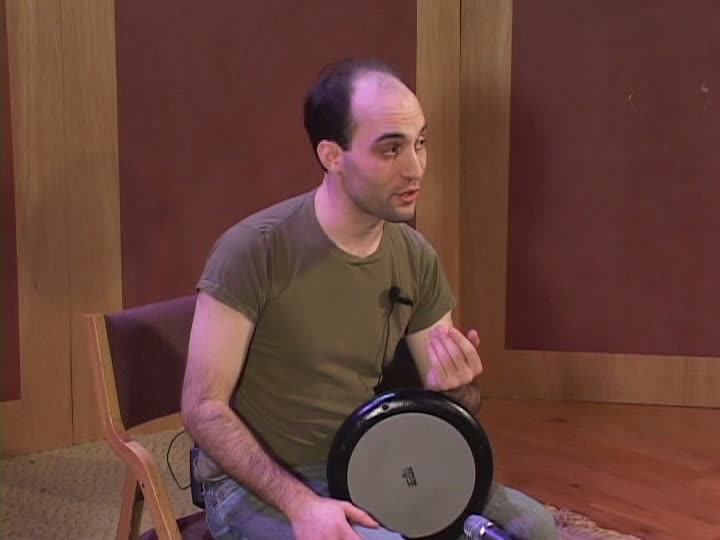
I recently started working with Carmine Guida’s Baby Beginner Doumbek Workshop, a super basic and gentle introduction to the doumbek. As I wrote in the earlier post, I don’t think it makes sense to try and learn all these rhythms in a day: for beginners as rhythmically-challenged as myself, that’s a hopeless proposition!

Cross training the ring fingers!

Although I only popped the video in for the second time yesterday, the Doumbek Workshop has been with me constantly in the intervening time. Part of this is due to the brilliant idea to write down the rhythms on the inside cover of the CD. I was a fan of this from the start, and I’m even more enthusiastic now. Because, while I began working with the video by learning the maqsum and baladi basic forms, as I practiced on my own I noticed that the saidi basic form has beats on all the same accents. Pretty soon, without even getting further in the video itself, I was switching back and forth between the three rhythms, speeding them up, slowing them down, and so on.

The other thing I’ve noticed is that for the first time, I really am starting to identify rhythms in the Middle Eastern music I listen to. Not all of them, and not all of the time, but every now and then my ear will tune in and pick one out. And once I do, dancing to it becomes even more natural. This is precisely what I hoped for, and I don’t think it would have happened just watching bellydance rhythm instructionals. 

My husband, who is musically gifted, hearing me practice, picked up both the doumbek and the rhythms in a moment flat, and started filling them in. He hasn’t even watched the video, but he doesn’t need to! We’ve now had a few lovely sessions of him drumming, both Middle Eastern and other beats, and me improvising some bellydance moves to it. Needless to say, I am thrilled. I, who have never really performed in public, now get to practice improv drum solos with my own live musician!

I returned to video practice by running the maqsum, baladi, and saidi segments, the last of which felt like a repeat due to my intervening practice, although I hadn’t actually watched it yet. And then came the time, the time for… the dreaded ka.

Carmine demonstrates how not to do the ka.

My first doumbek classes were in a world drumming course, so half the students had djembes, and half had doumbeks. We learned our first rhythms holding the drums between our legs, which effectively also meant that I learned to do the ka with a few fingers of my left hand, pretty much like the tek. And that was fine, except I could also see that most doumbek players don’t do it that way. Carmine teaches a version in which the ring finger of the left hand produces the sound.

Now this is hard. I was very glad that when he introduced the ka, and most of the students in the drum circle could do it right away, he pointed out that they were repeat students and that getting any kind of ka sound on the first try was a triumph. He gives quite a few tips for placement of the hand and arm, and how relaxed they should be, that do increase my ka batting average. To my surprise, however, learning the dancey ayub rhythm actually helped me get the sound more frequently. Even though once Carmine sped that one up, I got lost again. Well, now I know what my homework is!

Mala on setting up a dance practice

If you haven’t had a chance to read it yet, do go and take a look at Mala’s post on setting up a dance practice:

http://malabhargava.com/belly-dance/your-kind-of-practice.html

This is something I’m obsessed with, since I have so many videos, so much enthusiasm, and so little time. The best thing I’ve done for my practice is starting this blog and trying to review videos more often — it motivates me to work with new programs and revisit old ones.

But what spoke to me most about Mala’s post is this: sometimes we amateurs want to be super-organized and ambitious about dancing, especially when we fall, and fall hard, for something as enchanting as bellydance. But the thing is, it’s sometimes good to remember that we’re not professionals. That doesn’t mean not taking dance seriously, but it does mean that we have to remember to have fun with it, because nobody is giving us a grade or a cheque at the end of our dances. We’re doing it for ourselves.

Review of Rosa Noreen’s Delicious Pauses

Belly dance videos have come a long way since I made my first purchase, over ten years ago, of a Veena and Neena video that consisted mainly of them hopping side to side for what seemed like an eternity. We got better “basics” videos… then we got better workouts, and better drills… videos focused on all kinds of specialized forms of the dance (can you say “tribal style iranian-texan fusion with double feather poi and an isis tail”?). But one of the most inspiring innovations in the industry, from where I sit as a consumer and lover of dance, has to be the videos that deal with high-level dance concepts: how to refine movements, the tricks of performing, and how to convey a feeling or tell a story with dance. Rosa Noreen’s new DVD, Delicious Pauses: Negative Space in Movement, is just such a program.

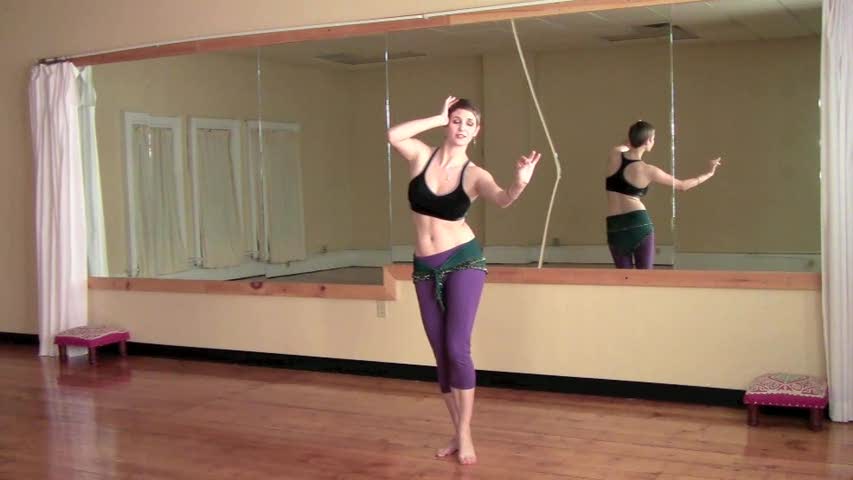
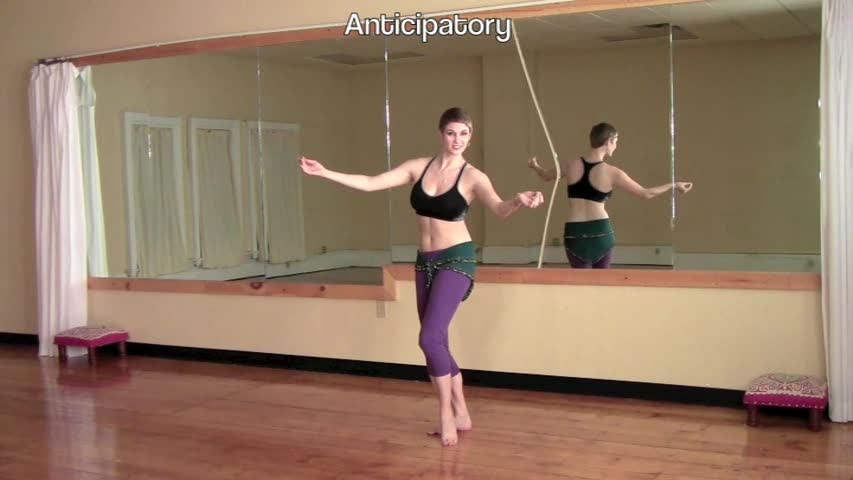
Now let me start by saying that I have my biases when it comes to bellydance. While there are many fabulous dancers who practice forms of it, the ones that make me happiest to watch — and who most make me want to dance — are those who dance with a certain kind of simplicity. Now, that doesn’t mean simplicity is easy to achieve, but rather that they imbue the most basic movements with expression, fluidity, tension. And this is actually hard work. So right from the start, I was drawn to the concept behind Delicious Pauses: using drawn out movements, dramatic stops, and “negative space” to keep the audience engaged and interested.

The DVD itself has three sections. The first is a theoretical introduction, in which Rosa Noreen describes the kinds of pauses she will teach later in the DVD, along with some other principles of her methodology. I won’t give away the whole bag here, but I will say the most interesting for me was her use of breath to aid either a sense of calmness or a dramatic move. I’m used to thinking about breath in yoga, but have never managed to do it much in dance, and this video really made me see how integral a part of dance conscious breath (and not just remembering to breathe) can be.

If you’re like me, the theory will leave you interested but confused. This is where the second section comes in, a series of detailed exercises in which Rosa Noreen has you practice the different kinds of pauses. Now, this is very methodically done: for, say, undulations, she reviews all the principles, shows you how different pauses might work with an undulation, has you practice them in a follow-along drill (no talking, just on-screen text), and then has you improvise using the same movements.

I loved how incremental this strategy was, and how it kept building up on itself. Rosa Noreen repeats the concepts a lot, but it turns out they mean different things when applied to different movements. Having the theory and then showing all the ways it can be applied using practical exercises is just excellent teaching, in my opinion. And while only the main sections are in the DVD menu, the chaptering is detailed enough that I could easily skip to a certain section or repeat what I needed.

What I found was that once I hit the “improv” segments, my body started taking over… but it also started almost unconsciously incorporating the different kinds of pauses into other moves as well. This is really superb training for improv, because it’s not about doing a million moves, but about being able to vary the basic moves in interesting ways. By the end of this video, you can do six variations on a horizontal hip figure 8 without really even thinking about it too much!

The final section includes two combinations that have you practice the pauses and concepts, this time in a slightly different way — for example, with a languorous sweep of an arm, or a intentful pose. To be honest, they didn’t look like much when I watched them, but I did find when doing them that they also “taught” in a different way than the theory and exercises. The combos are presented and drilled in super small increments, then added together, re-explained, and drilled. For someone who has an easy time learning choreography, this would probably be tiresome. I am not that person, so I happen to be happy for very slow choreo teaching, and kind of wish every teacher did it this way!

Delicious Pauses is only about 75 minutes long, but it contains material that will be worth going over repeatedly. Although all the instruction is with bellydance moves — and you do have to know the moves already — the concepts could be more generally applicable to dance. I’ve watched it through once and then worked with the exercises and choreo once, and already I feel different performing the same moves. I have a better sense not just of what it’s like to slow down (and in fact, it’s harder to slow down than to speed up), but the kinds of effects and sensations I can get from varying regular speed, staccato, and slow movements.

This is really smart stuff, and lot of thought and care has been put into the making of this DVD. We’re light years beyond Veena and Neena’s “genie hop.”

Delicious Pauses is available at Amazon via the link, and from http://rosanoreen.com/. I received a review copy of the DVD from Rosa Noreen.