Review of Kaeshi Chai’s Expressive Bellydance Veil

Years ago, when I lived briefly in New York City, I managed to catch a few bellydance workshops and classes here and there. I took classes at Serena Studios (I think I still have my card with a few unstamped spots on it), and took a veil-oriented class with Elena Lentini in which I managed to wind up more tangled and dazed than I care to admit. During one of the workshops I took, I remember noticing Kaeshi Chai quietly doing her thing at the side of the room, and being impressed that a dancer who was already well known was continuing her training with us plebes. So when I saw Kaeshi begin her veil video by acknowledging her influences, among them Serena Wilson and Elena Lentini, it was a full-blown dose of New York nostalgia.
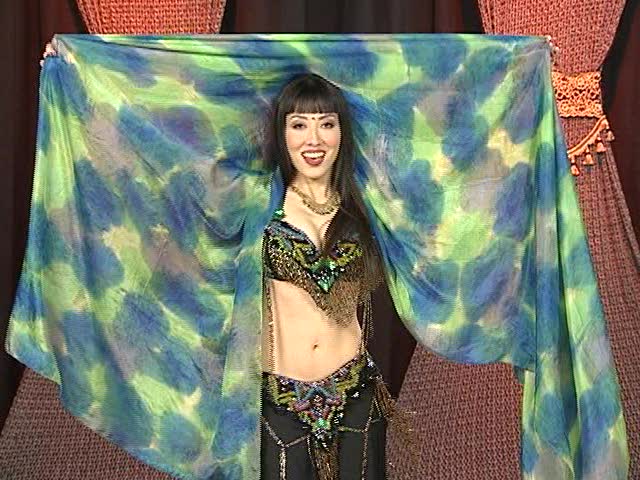
Kaeshi Chai’s Expressive Bellydance Veil is a compact introduction to a range of veil moves. I approached it as a beginner in things veilish, having had very little veil work in class (hence my confusion in Lentini’s studio), and not having worked with any other veil DVDs yet. Kaeshi begins by describing different kinds of veils available and explaining how to steam it. (Useful!)

As for the rest of the video, I think it’s best to think of it as a sort of movement encyclopedia. She introduces basic veil moves (like “around the world” and “butterfly”) in one section. This is followed by six combo sections, three with veil moves that begin from the front of the body, and three beginning in the back. In each combo, Kaeshi actually presents another three veil moves, and then puts them together into a small combination, which she repeats a few times.
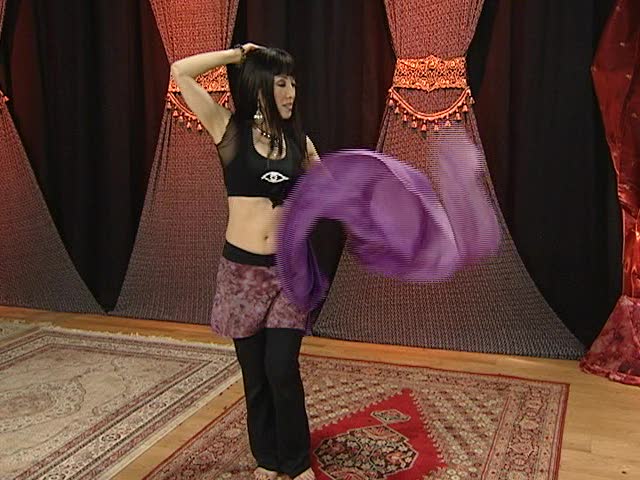
The instruction is careful, but quick. Kaeshi will often show how a move looks, then demonstrates it slowly, often setting the veil down to explain the hand or arm paths without it. Then she has a few more practices, sometimes giving little tips along the way. A couple more sections after the combos show you how to move into a vertical hold on the veil, and show veil ropes, turbans, and whips.

My experience was that I was surprised by how quickly I got some of the moves, and how frustrated I got with others. The DVD doesn’t have a lot of drilling, so I think to make it work you really have to focus on little bits — take it one move at a time — and just practice, practice, practice. I’ll clearly need quite a few tries to get a sense of the weight of my veil and how not to get it in my face every time I do the butterfly. I would also suggest doing a warmup focused on the upper body before beginning, since your arms, shoulders, and neck will benefit from being loosened up, and then ending the practice by stretching these muscles.

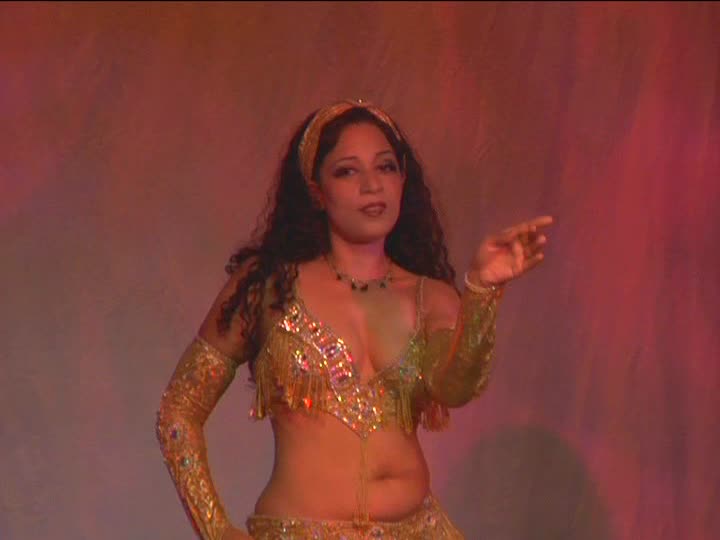
The final segment of the DVD is a costumed performance by Kaeshi that uses all of the moves she presented in the DVD. It’s very lively and peppy, not the sort of romantic and languorous dance one often expects with veil, and it was nice to see that the veil can be used for a variety of effects.

Because I’m almost an utter beginner, pretty much all of the veil moves were new to me. There were no veil wraps, which I actually have done in class, but there were to-me-unexpected moves like whip and rope that used the veil for a fast, dramatic effect. Will you like the video? The DVD is well chaptered, and Kaeshi is personable on screen. At 50 minutes, it moves very quickly through a lot of information, so you have to be willing to stop and drill on your own. And while there is a bit of attention to how certain veil moves or arrangements might work with particular bellydance moves or steps, the focus here is clearly on what you can do with the veil itself rather than on creating a whole dance.

I think this video would be good for someone who would like a manageable introduction to holding and using the veil, or who wants to add some new veil moves to their repertoire. I don’t think it would satisfy someone looking for a long, everything-about-veil video with lots of drills and choreography. As for myself, I really enjoyed it because I was able to fit it in at the end of a long day, and can imagine returning to practice individual moves, which is my level right now. But it also made me curious for more on how to put a dance together!

Expressive Bellydance Veil is also available from Hollywood Music Center (from whom I got a review copy).
New Look

I’ve been experimenting with the look of the blog lately, and for now have settled on Blogger’s new dynamic views. I did love my old header image, but wound up not so fond of the colour. For some reason, any scheme I picked to go with it wound up looking kind of… barfy. And “barfy” is not the best colour for a blog!

I don’t like that the dynamic views are not as customizable as the usual blogger templates, but I love that they make it so much easier to scroll through lots of posts. The Flipcard view is particularly good for that. So do play around with it, and tell me what you think!

Review of Tracey Mallett’s 3 in 1 Pregnancy System

There are a couple of things that are confusing about Tracey Mallett’s pregnancy videos. The first is that she’s done two, 3 in 1 Pregnancy System and Fit For Pregnancy. I have both, and if you read their covers they seem pretty similar. Both make a big deal about being 3-in-1 in multiple ways — three stages of pregnancy, three disciplines (yoga, pilates, and sculpting), and three body sections. This makes it seem as though you’re going to get some kind of complicated modular system with an elaborate DVD menu. This is not the case.

Look! Normal sofa cushions! I have those too.

At least as far as 3 in 1 Pregnancy System, which I did this morning, is concerned, what you get is a simple, hour-long workout that does indeed balance all the body parts and draw from different movement practices, and that has modifications for the third trimester. And you know what? That’s just fine. The video really hit the spot for me, and if anything, I’m rather relieved that I could just do it without making too many decisions.

The workout is divided into four sections (four? four? what happened to three?!):

Warm Up & Core Conditioning
Lower Body
Upper Body
Partnered Flexibility

Tracey has you mainly warm up using yoga moves, but most of the video seems pilates-based. I’m near my due date and not feeling that strong right now, despite maintaining a movement program, and I was able to do all but one position in the entire video — the plank. There is a modified hundred, which I haven’t seen on other prenatal videos, more abdominal work that is challenging but just barely doable for me right now, and some nice leg strengthening exercises. The toning moves are mixed in with some very satisfying stretches, which I really like. And the upper body section uses light weights to give you a little bit of muscular work.

So far so good. Sounds pretty basic, right? It is pretty basic. But I liked it. Tracey herself is adorable — she has an English accent, is pregnant in the video, and often jokes about not being able to perform certain movements anymore. She somehow makes the video really cheery and lighthearted. The attention to making moves comfortable for pregnant women is constant — I never felt rushed when moving from one position to another, always had time to get a sip of water, and even difficult moves felt controlled and well cued.

That’s it. I’m never going back to cushion-less pilates.

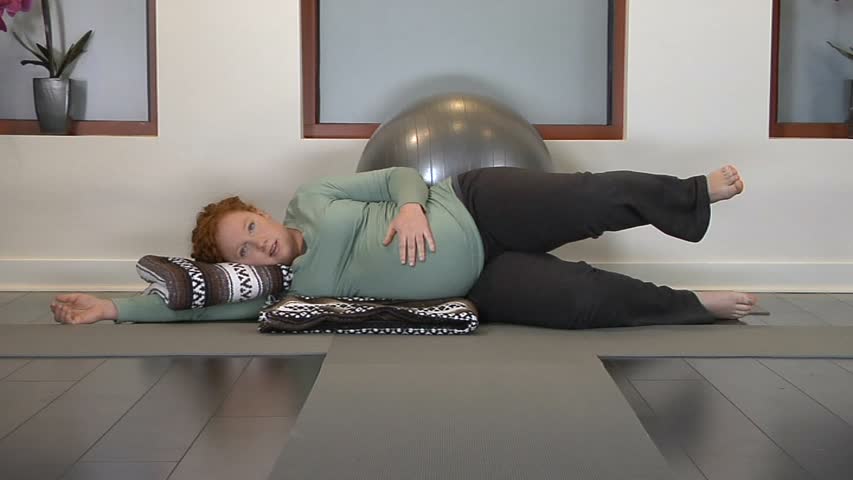
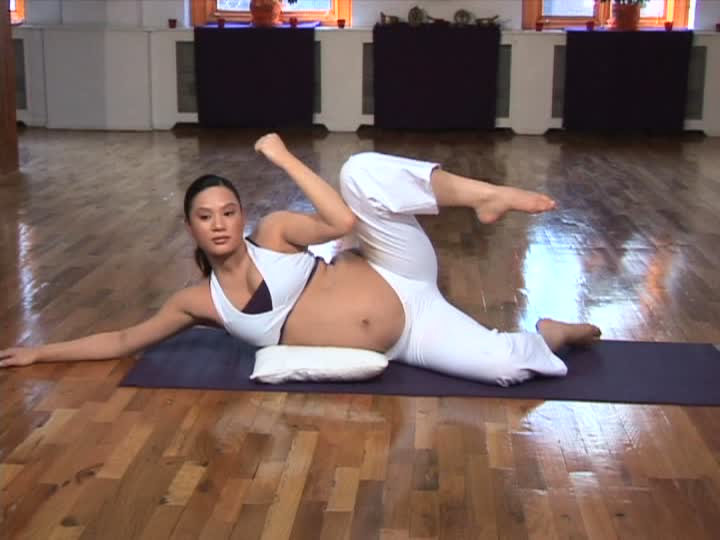
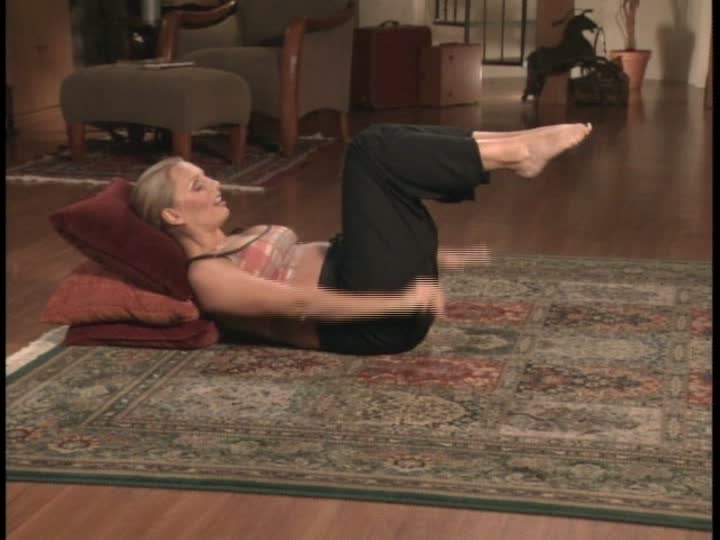
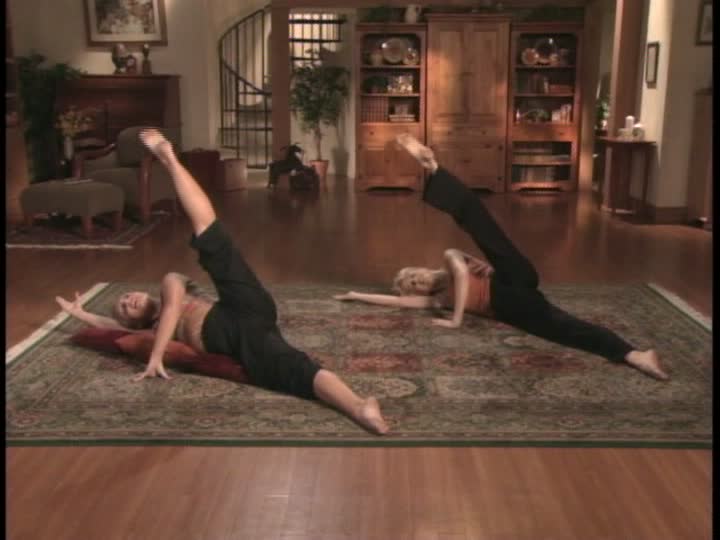
There is minimal prop use, but it’s also thoughtful. For example, Tracey has you use a folded towel under your palms to reduce the strain on the wrists in push ups (and it does!). She also has you use three cushions under your body while doing pilates leg exercises, and it makes the whole thing sooo much more comfortable! And guess what — these are not specialized yoga pillows or anything, but just regular sofa cushions. For once I didn’t have to adjust for the fact that I don’t have a yoga bolster in some kind of very specific shape.

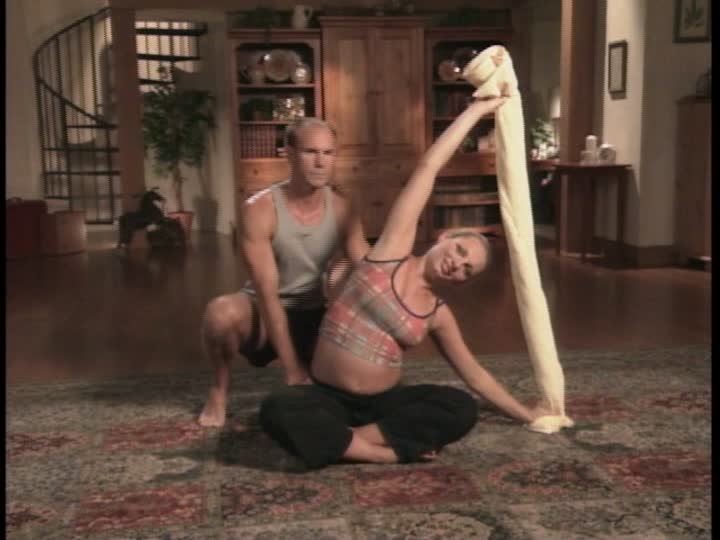
What ruins the numerology of the program is the “partnered flexibility” section — but while it spoils the numbers, it really makes the video. Tracey has her husband come in and help with some gentle stretches, most of them focused on the upper back and neck. Now, I did not get help with these, but Tracey’s husband often provides tips on how to do them alone. And still, they were so, so good. It’s easy to forget that pregnancy will take a toll on the upper back and neck too, and I suffer from tightness in that region anyway. (Who doesn’t?) The super-precise instructions given for these stretches gave me much deeper, more satisfying stretches than I usually get, and I expect to turn to them again and again just to deal with computer-related stiffness.

Husbands make great props, it turns out

So there you have it. Tracey Mallett’s 3 in 1 Pregnancy System is not nearly as complex as the cover would make it seem, but it challenged and stretched me in just the right ways for the third trimester. I can imagine doing it as a postnatal exercise too, as a way of gently building up strength again.

Working with Carmine Guida’s Baby Beginner Doumbek Workshop

Take enough bellydance classes, listen to enough Middle Eastern music, and eventually you have to come to terms with a simple fact: you’re going to have to learn to recognize and dance to the rhythms.

DOUM!

Now, I’m guessing that for most people this is not a hardship. Then again, most people can clap in time with a crowd, whereas I was always the person who clapped exactly halfway between the beats. I’ve had people explain some bellydance rhythms in class, but that’s just way too little exposure to really learn. I’ve played around with the rhythm lessons on videos like Jenna and Raquy’s The Heartbeat of Bellydance: Rhythms & Belly Dance Combinations for Drum Solos, but although that kind of program is valuable for learning how to dance to rhythms once you know them, for me it was still too little.

Eventually I recognized that if I really wanted to improve my sense of rhythm, I’d just have to ahead and learn how to drum. And frankly, the doumbek is a pretty sexy musical instrument. Did I mention I’m also pretty unmusical? So an instrument where I wouldn’t have to worry about melodic pitch really appealed to me.
This is by way of introduction to Carmine T. Guida’s Baby Beginner Doumbek Workshop, a DVD that starts at the beginning — at the very, very beginning — of learning how to play a doumbek. Which is great, since I think a lot of the material you can find assumes some facility at drumming, and goes at a pretty fast pace. But I’m not the only dancer who has wanted to learn a bit of doumbek, and the fingers we learn to move so gracefully are not always adept at making dums and teks!

Although I have a review copy from Carmine, I think it actually doesn’t make sense to watch the video once and review it. I do have a tiny bit of background: I took a world drumming class this spring, and whether we used doumbeks or djembes, we learned new rhythms very slowly, and were taught to practice them a lot. So I’ll work with the video gradually, and let you all know how it goes.

Some first reactions: 

The first cool thing you’ll notice is not even on the DVD — it’s the inside cover. Open up the cardboard DVD case and you’ll see all the basic rhythms taught in the main workshop. I think this is nothing short of brilliant. Simple, but brilliant. I’m a visual person, and I often need to see a rhythm written down as well as to hear it. However, files included on DVDs tend to be annoying to work with, since I’d have to print them or the like, and just having the rhythm pop up on the screen means that I can’t practice with it. Having a handy, portable guide to the rhythms is wonderful, because I can use it to practice without even putting on the video.

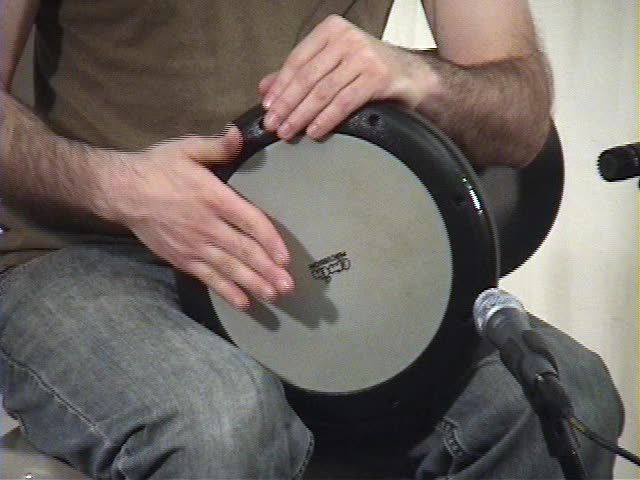
The instruction is a filmed workshop, and Carmine begins with the very basics: how to hold the drum, a relaxed posture, finger positions, and how to hit the drum with the dum and the tek. My previous teacher had us do our teks with more of a closed hand (or maybe I just followed incorrectly!), and following Carmine’s instructions gave me a nicer sound that was easier to achieve. A few basic drills (again, all different from what I’d done before) help students switch between dum and tek — trickier than it sounds at first.

I recognize that look of intense concentration…

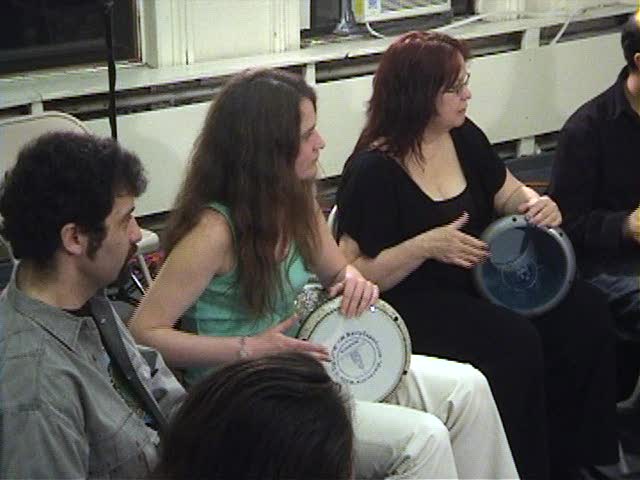
The workshop context is actually really nice. This kind of thing can be distracting in dance instructionals, but with drumming, where so much is about getting into a groove with others, it really makes sense. Carmine jokes around with the students which makes the whole thing more fun, and when he corrects them I notice that I was making the same mistake.

The thing that was very different from my class was this: while we were taught to count out rhythms, Carmine teaches them by sound. I worked with the sections for maqsum and baladi to start with. In each, he plays the very bare bones of the rhythm a few times slowly, then has the group join in and repeat. Once they get it, he might embellish the rhythm a few times, regularly returning to the skeleton form. On the one hand, I’m used to counting and missed it a bit. On the other, I liked that this way of teaching taught a focus on the general shape and sound of a rhythm, rather than an abstract count. Some of the workshop members seem to be dancers, and certainly much of the audience of the DVD will be too, so it makes sense to teach a kind of instinctive feeling for how the rhythms sound.

So far, I’m already excited about getting up tomorrow morning and tormenting my neighbours with baby maqsum and baby baladi! Next time: saidi, and my personal nemesis, the dreaded ka.

Baby Beginner Doumbek Workshop is also available at http://www.carmine.com/.

Review of Jennifer Gianni’s Fusion Pilates Birth Ball for Pregnancy

Jennifer Gianni is a pilates instructor and doula, and she has a number of DVDs out that offer pilates-based exercise programs for women to use while pregnant, after giving birth, and even with a baby in tow! Her most recent offering is a 3 DVD Box Set offering all of these options but using the Swiss ball (or “birth ball,” as it’s sometimes called) to guide the exercises. I received the set as a review copy, and since I’m still waiting for my little one to arrive, have worked with the first video in the series, Fusion Pilates Birth Ball for Pregnancy.

Modifications for different trimesters are often shown and explained

Gianni’s expertise in crafting careful prenatal workouts really shows in this program. The first section, “Fusion Essentials,” is really a long introduction to working out with the ball, doing pregnancy posture checks while sitting and standing, safe abdominal work, and pelvic floor exercises. This isn’t a workout: it’s more like a lecture interspersed with exercises you can do. Some sections, like “ab curl safety,” were not relevant to me yet, but I found the pelvic floor section really interesting. This is the first video I’ve ever seen that has suggested different pelvic floor exercises for different periods of pregnancy. More precisely, Gianni gives you exercises for strengthening and tightening the pelvic floor during the first and second trimesters, but for the end of the third trimester has you segue to practicing the relaxation of the pelvic floor. Kind of makes sense, no? Most of the pregnancy is about keeping the baby in, and the very last bit is about getting it out!
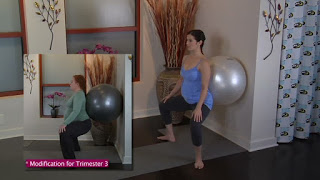
The workout itself is composed of careful, small movements that work a variety of muscles. However, the point is not to feel the burn. I did this workout at 36 weeks and on a day when I really wasn’t feeling very strong, and still didn’t really feel “worked out.” Instead, the program seems to be more about using the ball to complete movements safely and veeeeeery precisely. Most of the workout is performed by a model who is well into her third trimester — and I think this would be the best target audience for the video anyway — but modifications are often shown in an inset window.

I think this program is really ideal for women in their third trimester, or women having pains or other difficulties during pregnancy. Jennifer Gianni is clearly aware of a pregnant woman’s potential limitations, and no exercise feels like it would be unsafe or jarring in the slightest. Some exercises are really delightful variations on moves you might know from other workouts — for example, doing squats with a ball behind you gives you a much more controlled movement that feels secure in late pregnancy.

That said, it’s really best called a “program” and not a “workout,” because if you want to sweat or feel muscular pain the next day, this is not the right video for you. I didn’t feel anything the next day — but I also didn’t feel any pain. It was a good way to get moving on a low-energy day, and to feel that I did something for my body without pushing too hard. It wasn’t a good way to tone my butt, even though there was a cool pilates leg exercise that did use those muscles.

Finally, a few small details about the DVD setup both positive and negative. I really liked that the sections are individually titled and divided, so you can skip easily to the beginning or end of a section. Also, the DVD has an index that has all the sub-chapters in both “Fusion Essentials” and the “Main Workout.” So if you want to work on “Releasing the Pelvic Floor,” you can jump right to that without the pelvic floor intro or strengthening exercises. Great.

My complaints have to do with the setup in my home, and how I do video workouts. Most of the ball exercises required a wall, and most of my walls are covered in bookcases! It was pretty hard to find a spot in my apartment where I could see the screen and have access to enough wall to make the workout work. Also, the exercises often require a bit of setup, but the section begins with ball and sometimes blankets already in place. In practice, this meant I had to get up, pause my computer, set up most of the stuff, rewind to the beginning of the section, then get quickly into position so I could do the exercise. And at 36 weeks, I just don’t move that fast. If I were watching the video on a regular tv and had a remote control, it wouldn’t be so bad, but again, my particular situation, in which a laptop is how I watch DVDs, made the video less convenient to use than it could have been.

Fusion Pilates Birth Ball for Pregnancy is also available from http://www.fusionpilates.com/.

Review of MommyShape Prenatal Complete

If you’re looking for a moderately challenging, customizable workout to keep in shape while you’re expecting, MommyShape Prenatal Complete could be just the DVD for you. I received a review copy from its creator, Diane Angela Fong, and was very pleased with the program, though I think knowing what you’re getting is the key to being satisfied with it. So far, I’ve worked with it twice, taking advantage of its modular structure. I haven’t done every exercise on the video, but I have used it in two ways I consider typical.

Structure

The workout is basically divided into five sections:

Warm Up
Sculpt & Stretch
Dance it out!
Yoga & Relaxation
Cool Down

The times for these are given, and you can pick and choose which you will do, though you do have to click again for a new section. Doing all of them would take about 70 minutes, which if you’re heavily pregnant you might find a bit much (though I would have done it easily earlier in my pregnancy). But this morning, for example, I did the Warm Up, Dance it out! and Cool Down segments, which took a little over half an hour, and I felt like I got a good workout out of it. At the beginning of each section, Diane tells you what props you’ll need for that section, which is a good chance to pause and get things in place.

But here’s the kicker: if you want a little bit of each, you can also do the “MommyShape Complete” workout, which has segments from each section, and is 50 minutes long. I actually did this version earlier in the week, and I really like the inclusion of this option. I love it when DVDs have a lot of material, but if a program is too long, it can become overwhelming, and I’m less likely to use that DVD when I’m busy. So having a simple, one-click workout that will provide a bit of cardio, a bit of sculpting, and a bit of stretching, is just right, and a great introduction to the DVD.

Difficulty

Diane is a professional dancer, and despite being 35 weeks pregnant in the video, is in excellent shape. She moves quickly from one position to another — much faster than I could! Especially in the sculpting and yoga sections, there are modifications to make positions easier depending on your level or trimester, but I can tell you that despite partially modifying, I really felt a burn in my thighs the day after doing the “Complete” program. (In a good way.) If you’re not in the habit of watching a video through before doing it (and because of time constraints, I’m not), you may be frustrated with how quickly Diane moves. However, this could also be a positive — when you’re doing a segment for the second time, you’ll waste less times with explanations and lengthy setup.

Dance

The dance segment is also tricky, but lo and behold, there is a separate 15-minute dance instructional that goes through the moves more slowly. The first time I did the video I didn’t bother with this, impatient chipmunk that I am, and I was able to follow along with almost everything just fine. I did watch the instructional before doing the program again, and that helped, but it’s not strictly necessary if you have dance experience.

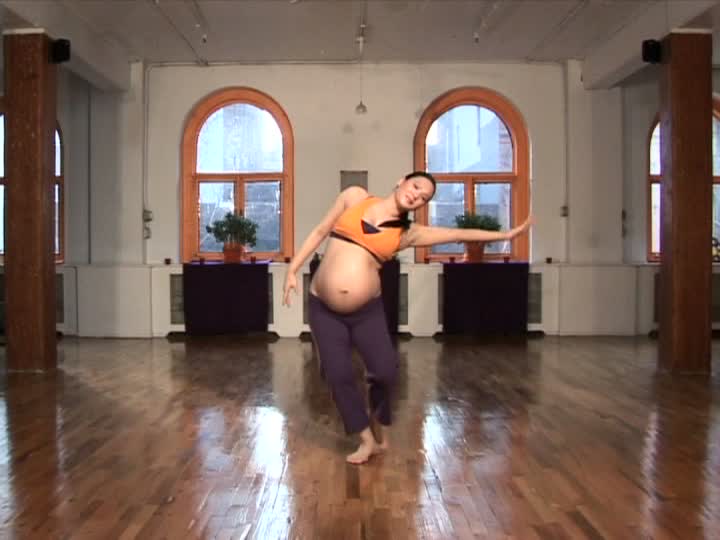
The dance itself is a cardio workout with a mix of bellydance, African, modern, and Latin dance moves. Diane repeats it three times, using arm variations to keep it interesting, and then does a modified, slowed-down version for a cool-down. I have to say I really liked this segment, despite, or maybe because of the fact that it’s so different from my usual bellydance. Diane performs the moves with grace, which I find inspiring, and for a while there I felt that I was taking a modern dance class in an airy California studio. (Instead of, you know, in my living room.) And I really felt tired by the end.

My two warnings are that Diane doesn’t mirror, so you have to adjust for left and right, and while there is light rhythmic music in the background of the dance segment, the dancing is not done to the beat. These didn’t throw me off, since the general feeling of the dance portion was more loose and flowing, but they could if you are expecting mirroring and timing.

In sum, MommyShape Prenatal Complete would be great for you if you are earlier on in your pregnancy or have maintained a light workout routine, if you can adjust for left and right, and if you have some experience with basic dance moves. At 35 weeks, I find it gives me enough of a workout to really feel I have done something — beyond just stretching — but is still doable. If you are completely out of shape and/or want to be able to get everything on the first go, this is probably not the best program for you. My favorite aspects of the DVD are that it’s customizable but doesn’t force me to make decisions if I don’t want to, and that the dance segment is fun and well-performed.

MommyShape Prenatal Complete is also available at http://mommyshape.net/.

Pining for Pina

If you’re anywhere near a movie theatre that’s playing Pina right now, open a different browser window, buy a ticket, and go to see it immediately. Do not pass Go, do not collect $200, just head straight to the cinema. Trust me.

Some of the theatres in my city are playing it, both in 2D and 3D, and I’ve been recommending the movie like mad to anyone who will listen. I saw it twice this past summer in 3D while I was in Germany, and will probably see it again, in however many dimensions I can, before it leaves the cinemas again. “Pina” is probably one of the most exquisite things I’ve seen on a movie screen. If you love dance, if you love art or music, heck, even if you just like seeing beautiful things or fascinating people, you will love it.

“Pina” was originally planned as a documentary. Pina Bausch, one of the leading choreographers of modern German dance, was working with director Wim Wenders when, a few days before beginning the shoot, she died suddenly of cancer. Wenders wound up making the piece anyway, but it became an homage to Bausch herself. Pieces from her dance works are interlaced with her dancers’ recollections of working with her,of  learning their craft from a charismatic, understated, and powerful woman.

Why see it? The dancing is passionate, stunning, sometimes joyful, often troubling. The dancers themselves are equally fascinating; we are used to seeing the sameness of Hollywood faces on the big screen, but here are artists who can control every muscle and the intention behind it, and whose faces show the individual lines of long experience. The discussions of dance are incredibly subtle, and would be of interest to any practitioner. For example, in archival footage, Bausch describes performing a choreography that demanded she keep her eyes closed throughout, but feeling that this repetition was somehow different, not right — then realising that it made a difference to the feeling of the dance whether she looked up or down behind her shut eyelids. See it also because the cinematography beautifies Wuppertal, an industrial German city made enchanted by the dancing filmed in its parks, public transit, and mines.

Really — just go see it. Then come back and tell me what you thought.

Review of Secrets of the Stage Volume One

Secrets of the Stage Volume One: A Performance Course for Belly Dancers came out a while ago — 2007 to be exact — and around that time Michelle did a giveaway and I wound up with a copy. I remember watching it back then, but for some reason I wasn’t in the right place yet to appreciate the video. I’m not sure why. Maybe I didn’t have the patience to sit and watch dancers enough… or maybe I wasn’t thinking intensely enough about how to make bellydance my own. Whatever the reason, my current state, physically a bit slowed down but with an unusual amount of time on my hands, led me to turn to it again. I’m not looking to perform in the near future, so I’m really writing this from the perspective of a learning dancer who simply wants to improve, and to think more deeply about the dance I love.

Zari guides her audience

The video consists of several sections:

Calmness and Simplicity
You and Your Music
Focus and Energy Projection
Exercises

The four “theoretical” sections feature one or more brief introductions by Michelle Joyce which are then followed by full-length dance clips of dancers: Adriana, Nanna Candelaria, Sandra, Shoshanna, Zari, Zaheea, and Michelle herself. As you watch each clip, the dancer “narrates,” reflecting on the dance you’re watching or her dancing in general.

There are some truly memorable moments. For example, in the “Calmness and Simplicity” section, Adriana describes performing a glass dance in which the glasses cracked when she stepped on them. In the video, you cannot see her bat an eyelid out of time, but to hear her tell it, the crack was so loud that the front rows of the audience heard it.

In Adriana’s clip, the narration tells you the backstory behind a dance. In other cases, the dancer speaking teaches you how to see what is in front of your eyes. Zari performs a haunting dance to “Ana Bin Tezarek,” and part of what makes it so haunting, you learn, is the way she changes focus between her body, the audience, and so on. I think I would have noticed that Zari dances with varied expression and that she uses her eyes wonderfully, but I wouldn’t have known that it’s not just about looking up or down, but about guiding the audience’s interest in a certain conscious way. This doesn’t just tell me how to learn from Zari, but is also a kind of training in how to watch other dancers, what to look for, how to learn the craft.

Michelle demonstrates how dynamic sitting in a chair can be

One of the things I loved about this video was discovering a number of dancers I really, really enjoy watching. While all were lovely, I’m left wanting hours more of Zari, Sandra, and Nanna, all very different from each other, but all embodying qualities I adore about the dance. Another quality I loved was the focus on simplicity in the first section. There are a ton of bellydance instructionals out there that will teach you how to accomplish complicated drills and combinations, but how many, even five years later, reinforce the idea that simplicity in dance can also be beautiful and delicious to watch?

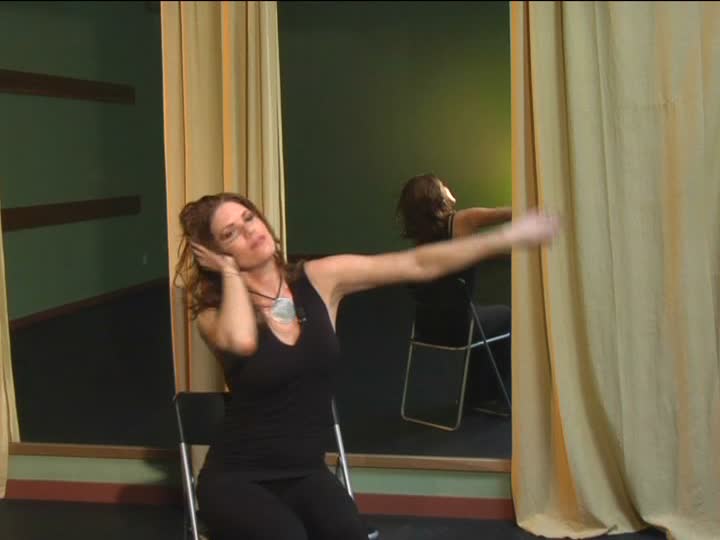
Finally, the exercises. There is a guided relaxation, a chair exercise in which you only dance with your upper body, an improv exercise in which you dance to the same short clip of music four times without repeating your movements, and a brief focus exercise in which you place your focus with intention. I did all of these (minus the guided relaxation) on a different day, when I was warmed up from another workout. And frankly, I thought they were kind of genius.

The chair exercise really forces you to exploit the movement potential of your upper body — chest, hands and arms, head, facial expressions. The improv exercise features seven different musical clips, and not only did it prompt me to be creative and to move across the floor more than I usually would, but it also made me listen to how different the clips were from each other musically, how each one “asked” me to perform different kinds of movements. The focus exercise was brief — I need to practice it with my own music — but I found it took my attention from my own body and its movements to points outside my body. This changed the feeling of dancing completely, and really allowed my body to react to the music on its own, without as much interference from me — if that makes any sense!

Even though I watched Secrets of the Stage Volume One all the way through twice and did the exercises, I feel I’ve barely begun to scratch the surface. There is so much information in here, too much to absorb all at once, and the real test will be to practice the exercises with my own music. Still, I found the video marvelously liberating — this is really a program about dancing rather than about performing a series of movements in a certain way, and as such, it is deeply pleasurable both to watch and to work with.

Secrets of the Stage Volume One is also available at Cheeky Girls Productions.

Amira’s Belly Dance for the miserable mornings

When I first worked with Amira’s Belly Dance & Yoga For Pregnancy (reviewed here), I really enjoyed it but wondered how often I would have enough time to do the full 1.5 hour workout. Oh, silly, innocent me! How naive I was as I was entering my third trimester. Little did I know in those halcyon days that sleeping through the night would soon become a special treat.

Backwards undulation as labour prep

So early this morning, sleep-deprived for a few days now, angry at the world and everyone around me, and having just felt my baby turn head up, I decided to give up on my ill-fated attempts to fall asleep again. I had a meeting to get to in the morning, but still plenty of time to get in, well, a full 1.5 hour workout — and after several restless nights, my body needed it.

Let’s just say this: the careful yoga stretches and deliberate and beautiful bellydance movements took me from being murderous to being almost — happy! Once or twice, I even found myself smiling. Everything was much harder for my exhausted body to perform, but it also felt so much more necessary. This time, since I’m closer to my due date, I also paid more attention to the “Exercises During Labor” section. In fact, these exercises are also bellydance movements (pelvic drops, umis, and a lower-body backwards undulation), but I tried to imagine myself stringing them together during labour, mentally training for the big event. There were also yogic breathing exercises which I found amazingly soothing, including one that timed breathing to head rolls, which I think I could actually keep track of during labour! And the “Cool Down” section has a series of shoulder stretches that were particularly satisfying after nights of fighting with pillows and days of tensing up at work.

The last time I did Amira’s Belly Dance & Yoga it was fun. This time around, it helped me face the day. When I finished, I set up some couch cushions for a shavasana and pretty promptly… fell asleep!