One of my major weak spots in dance is the turn. This is the legacy of not having taken ballet classes beyond those miserable ten weeks as a child, but I don’t know how to spot, I have little balance, and I can rarely end where I’m supposed to. I still remember going to a trial class with a well-known New York City bellydance teacher, and her having the students do chaine turns across the floor. For some reason, the entire class seemed to be filled with pro dancers (and this was notan advanced class) who could chaine up a tornado if they needed to. I got dizzy after a few steps.
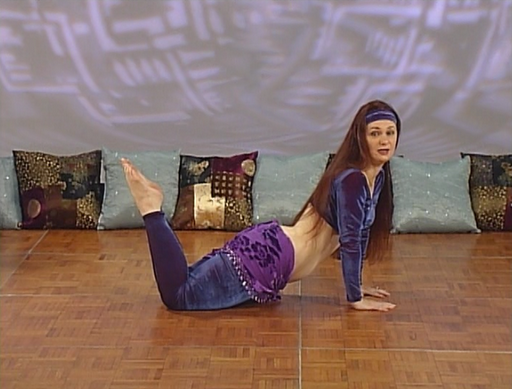 |
| The mermaid spin: not happening for me anytime soon. |
I’ve been working towards spotting in one of my weekly classes, where the instructor teaches it quite well. But I worked with Spins and Turns with Marguerite to see if I might learn any tricks that could help me outside of class time.
The verdict? Spins and Turns should almost just be called “Spins with Marguerite.” Well, that’s not totally fair, but the focus is very much on technique for performing extended spins and whirling. In this sense, it is varied and covers a lot of technique: Marguerite covers preparatory stretches (though no warmup), step turns, pivot turns, turns on releve, and barrel turns. She offers multiple types of spotting techniques, including a cool one that involves spotting on the ceiling. There are different kinds of arm positions, again, mainly to add interest to longer spins, or with veil. And there is a section on level changes, including the quite difficult “mermaid” spin performed on the floor. (This was painful enough that I realized after one try that it would be unsafe for me to continue on my own.) The head flip turn I didn’t even attempt – I knew that would be a bad idea. Finally, there are tips on shoes, surfaces, and even braiding a tassle into your hair. A couple of performances round out the video, an old school orientale performance in heels, with zills and veil, and an “ethnic” spinning dance in Central Asian-inspired costume.
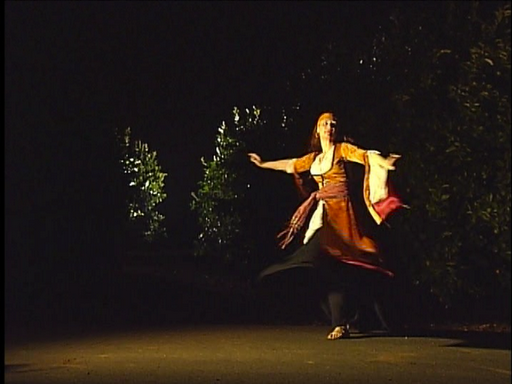
If you are looking to learn to spin for meditation or performance, this video would be just the thing. I imagine if you wanted to incorporate extensive spinning into a veil choreo, it would be useful too. It wasn’t quite what I was looking for, however. I usually encounter choreographies that have a few three point turns worked into other footwork, or several turns in quick succession across the floor. The video didn’t really cover these and it also didn’t quite tell me how to stop on point.
The other thing really has to do with me as a learner. Turns – both getting up to speed and spotting – are hard for me. Marguerite breaks things down very carefully. Nevertheless, when she goes up to speed I’m not sure how I’m supposed to make that leap. I’m still looking for that video that will help me with really minute, step-by-step instruction on getting brief turns just right.
 a t i s h e h